

If you are a golfer over 50 with a lower back that talks to you on cold mornings, you have probably already tried the usual answers. Stretch more. Swing softer. Skip the round and hope it settles down. I tried all of those, and none of them got me through a full season without at least one week of playing stiff. A Tuesday league friend named Ron finally handed me his TriggerPoint GRID foam roller after a round and said, "try this before you swing next time." I ordered my own that week, and it has been in my stretching room ever since. This is the honest version of that review, including the parts I wish someone had told me before I bought it.
I am Gary Lindqvist, 61, retired HVAC contractor, and I play a Tuesday league round and a Saturday round most weeks. My lower back stiffened up on the right side when I was 58, after a cold-morning round, and my doctor called it muscular strain. No surgery, no disc injury, just a back that needs more attention than it used to. I am not a doctor or a physical therapist, and I am not going to pretend to be one. This is one golfer's experience with one tool. The TriggerPoint GRID is not a cure for any of that. It is a tool that made my rounds more comfortable, and I think it is worth your money if you go in knowing what it actually does.
The Quick Verdict
A well-built 13-inch foam roller that genuinely helps with lower back stiffness before a round, as long as you accept that it is firm, it takes a few sessions to learn, and it will not fix a back that needs a doctor.
Amazon Check Today's Price →The foam roller I reach for before every Tuesday round
The TriggerPoint GRID is the roller that actually stayed in my stretching room. It is firm, it is simple, and it targets the right side of my lower back better than any smooth roller I have tried.
Amazon Check Today's Price on Amazon →How I've Used It
I have had the TriggerPoint GRID for about a year and a half. Ron recommended it on the course one Tuesday in the spring, and I ordered my own that same week. Before that I had a smooth foam roller, the kind you see in every gym bag, and it never did much for the right side of my back. The GRID's ridges reach deeper without me having to press harder, and that was the difference I felt on the first try. Most weeks I use it three or four times: once the night before a league round, once right before I leave for the course, and once on Sunday evening when I have stiffened up watching football on the couch. It lives in the spare bedroom I use for stretching, next to the door, so I do not have to dig it out of a closet.
The roller is 13 inches in diameter and weighs about 1.1 pounds, so it is easy to carry from room to room. The surface is what TriggerPoint calls a multi-density GRID pattern, with varying ridges and nodules that are meant to replicate the feeling of a massage. The item firmness description is extra firm, and that is the honest part of the listing. It is not a soft cushion. It is a firm cylinder with texture, and it is supposed to be.
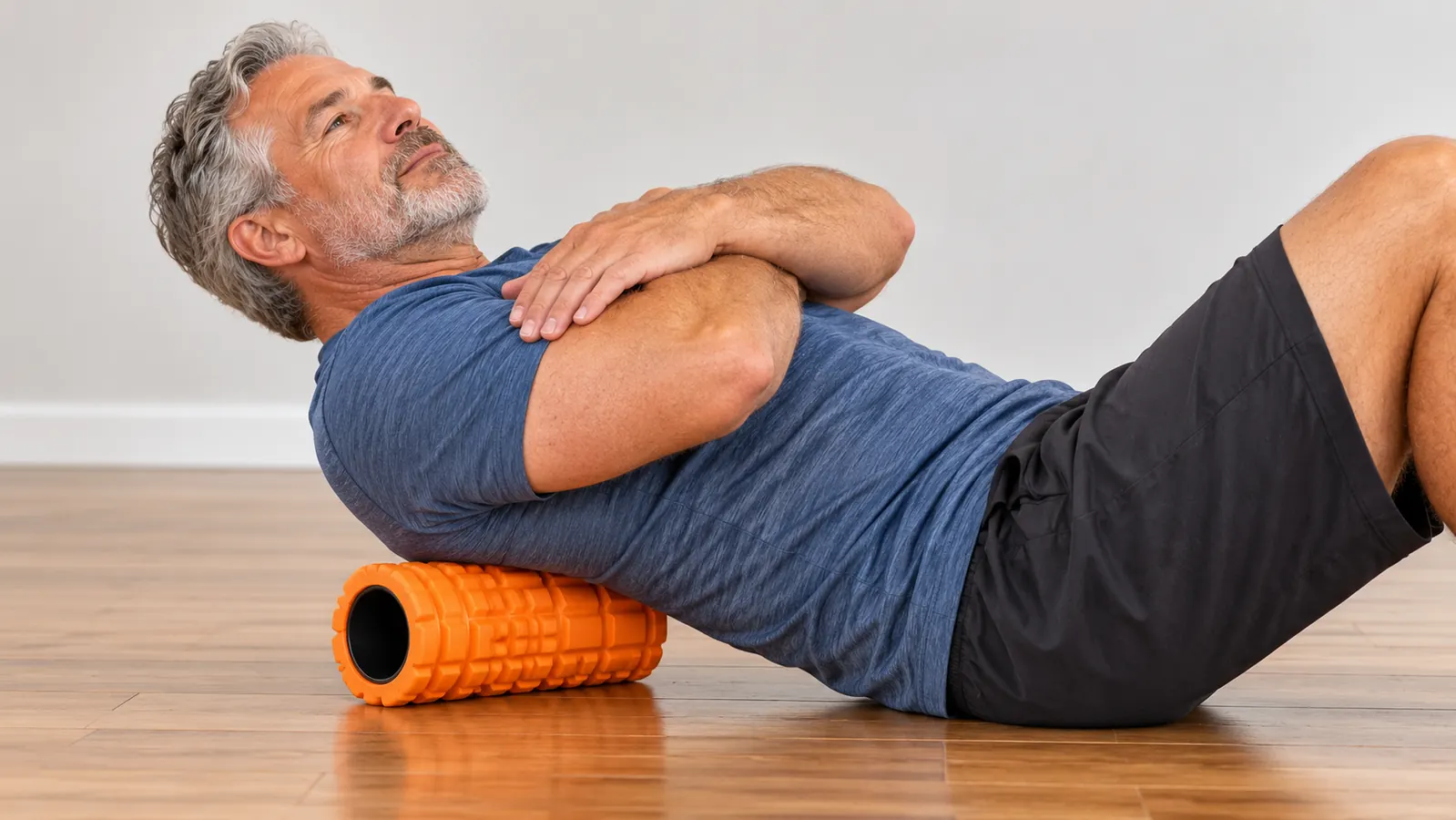
My routine is not complicated. I lie on the carpet in the spare bedroom with the roller under my lower back, knees bent, and I roll slowly over the right side where the stiffness lives. I do not roll fast, and I do not press hard. The first time I tried it, I made the mistake of treating it like a log and rolling the whole length of my spine in one pass. That was too much. The better approach is to move in small increments, let the ridges work into the muscle, and roll back and forth over a two or three inch section before moving on.
A full session for me is about ten minutes. I start with the gentler part of the surface on my upper back, then shift down to the firmer ridges on the right side of my lower back, where the stiffness has lived since I was 58. I finish with my hamstrings, which sounds unrelated but matters more than you would think. Tight hamstrings pull on the lower back, and a few slow passes on the back of each leg takes the edge off. On a Tuesday league morning I do the whole thing before I leave the house, and I have gotten the timing down to the point where I can do it in my golf clothes without making a mess.
What Nobody Tells You Before You Buy
The first thing nobody tells you is that the TriggerPoint GRID is genuinely uncomfortable at first. The extra firm density and the nodules are doing real work, but the first two or three sessions feel like you are lying on a textured brick. I almost put it in the garage sale after the first week. I am glad I did not, because once my back got used to the pressure, the discomfort turned into the kind of deep pressure that actually loosens things up.
The second thing nobody tells you is that technique matters more than the roller. The GRID will not do anything by itself. You have to learn to move slowly, breathe, and stop before it hurts. I watched a few videos and read the included component list, which is just the roller itself, no guide, no straps, no accessories. The learning curve is real, but it is short. After about a week, I stopped thinking about it and just used it. Now I can tell within the first few passes whether I am going to have a good back day, and that alone is worth the effort of learning the thing.
The third thing is the one I want you to hear: this roller will not fix a back that needs a doctor. I have had sharp, radiating, or new pain before, and when that happened I did not roll on this. I called my doctor. The GRID is for muscular stiffness and soreness, the kind you feel after a long round or a cold morning. If your pain is sharp, radiating, or new to you, check with your own doctor before you spend anything on any roller.
The fourth thing is more practical: it is loud on a hard floor. The textured surface against tile or hardwood makes a knocking sound as you roll, which surprised me the first time. On carpet it is quiet. My stretching room has carpet, so it is not a problem for me, but if your only floor space is tile, put a yoga mat or a towel under it. That is the kind of detail that sounds too small to mention, and then you are on the floor at 6:30 in the morning listening to a foam roller clatter and wondering why nobody warned you.
What It Does for My Golf
The honest measure for me is whether I make it through the turn without the right side of my back locking up. Before the roller, I would be fine on the first nine and stiff by the tenth or eleventh hole, especially on mornings when the temperature stayed below 70. Now I do a slow three minute roll before I leave the house, and I notice the difference most on the back nine. It is not that the stiffness is gone. It is that it shows up later, and when it does, it is a dull reminder instead of a sharp stop.
I can give you one specific round. Last October, on a Saturday morning at our course, the temperature was in the low 60s at the first tee, which is exactly the kind of morning that used to guarantee a stiff back by the turn. I did my three minute roll in the garage before I loaded my clubs, and I walked the front nine without thinking about my back once. On the fourteenth hole, I bent down to pick up my ball on the green and it just happened, no wince, no hesitation. That is not a dramatic story, but it is the honest one. Nothing dramatic happened. I just played a round without my back being the thing I thought about.
My swing is still a 16 handicap swing, and I am not suddenly flexible. I am not hitting the ball farther. What changed is that I am not wincing when I bend over to pick up a tee, and I am not standing at the tenth tee wondering whether to take a painkiller or just play through it. At 61, that is the difference between a round I enjoy and a round I endure. The roller is not the only reason, but it is the reason I reach for most often.
The Build and the Specs
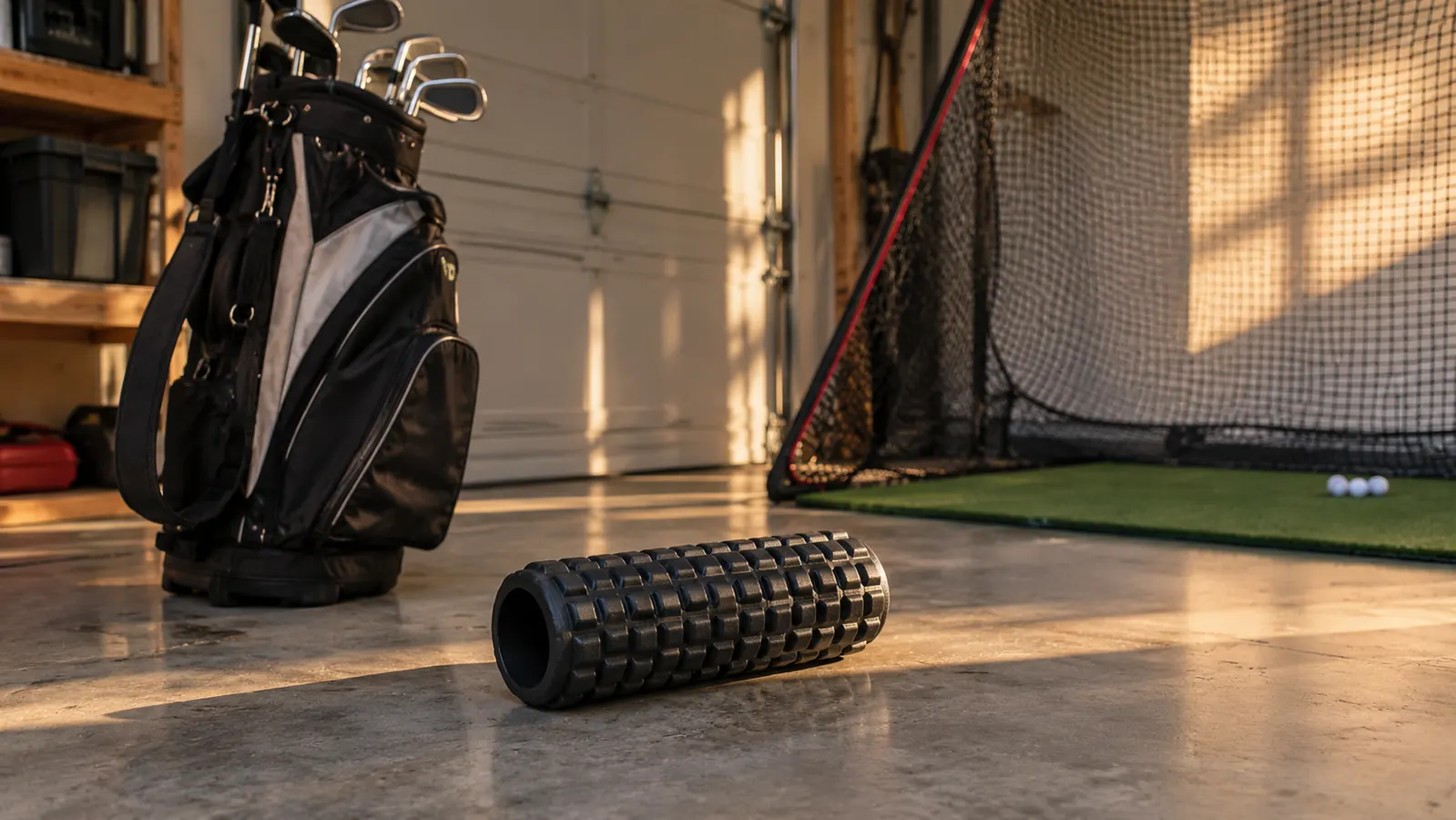
The TriggerPoint GRID is a 13 inch foam roller with a multi-density surface. The product dimensions are listed as 3.94 x 5.12 x 5.12 inches, and the item weight is 0.5 kilograms, which is about 1.1 pounds. The material is foam, and it is described as chemical free. The multi-density GRID pattern is the whole design: a three dimensional surface with varying ridges and nodules that is meant to improve muscle recovery and give a personalized rolling experience.
What that means on a practical level is that different parts of the roller feel different against your back. The firmer ridges dig in more, and the softer sections let you ease off. I use the firmer part on the right side of my lower back and the gentler part on my upper back, which is a level of control you do not get with a smooth foam roller. The whole body target use is accurate in the sense that you can use it on your back, legs, and shoulders. I mostly use it on my back, because that is where my stiffness lives. The first time I used it on my shoulder, I realized the same surface that felt harsh on my spine felt just right on a knot in my shoulder blade. That range is the reason it stayed in the rotation.
After a year and a half of regular use, the surface still looks the same as the day it arrived. No flat spots, no cracked foam, no chunks missing. I have dropped it on the garage floor more times than I can count, and it has held up. The only wear I can find is a slightly dusty patch where it sits against the wall in the stretching room. For a piece of foam, that kind of durability is the part of the value nobody talks about in the reviews.
What I Liked
- Extra firm density actually gets into the right side of my lower back
- 13 inch size is easy to carry from the stretching room to the garage
- Multi-density surface lets you choose firmer or gentler zones
- Held up for a year and a half with no flat spots or cracks
- No batteries, no app, no assembly, nothing to break
Where It Falls Short
- Genuinely uncomfortable for the first few sessions
- Loud on tile or hardwood floors without a mat under it
- Technique matters; it will not help if you roll fast and hard
- Will not fix a back that needs a doctor, and it is not meant to
I was stiff by the tenth hole most weeks. Three minutes on the GRID before I leave the house, and the back nine feels like the front nine again.
Who This Is For
This roller is for you if you are a golfer over 50 with muscular lower back stiffness that shows up after a round or on cold mornings, and you are willing to spend ten minutes a few times a week learning how to use it. It is also for you if you want a simple, durable tool that does not need batteries, a phone, or an app. There is no power cord, no remote, no timer, no dial. It is just a well made piece of foam, and sometimes that is exactly what you want.
It is also for you if you travel to courses where you ride instead of walk. I take mine along when I play out of town, because it fits in the trunk next to my clubs and it takes up less room than a pair of golf shoes. A hotel carpet works fine as a floor. That is a small thing, but it is the difference between using it and leaving it at home. The roller does not care where you are, and neither does your back.
Who Should Skip It
Skip it if you are looking for something that will fix your back without effort, because nothing will. Skip it if you have sharp, radiating, or new pain, because that is a doctor conversation, not a roller conversation. Skip it if you want a soft, plush cushion to lie on, because the extra firm density is not that. And skip it if you will not use it, because a roller that sits in the garage is just a piece of foam taking up space. I use mine because it is in the room I walk through every day, and that is the real trick. Put it somewhere you will trip over it, and you will use it. Put it in a closet, and you will not.
One more honest note: if you are the kind of person who buys a tool and expects it to do the work, this is not that tool. The GRID rewards the ten minutes you put into it, and it does nothing for the ten minutes you do not. If you are not going to put in the time, save your money. That is the advice I would give a friend, and it is the advice I am giving you. I did not like this roller on day one. I like what it does for my Tuesday rounds, and that is the only reason it is still in the room.
Buy it for the back nine, not for a quick fix
The TriggerPoint GRID is the roller I reach for before every league round. It is firm, it is simple, and it helped make my rounds more comfortable. If that is what you are after, it is worth a look.
Amazon Check Today's Price on Amazon →