
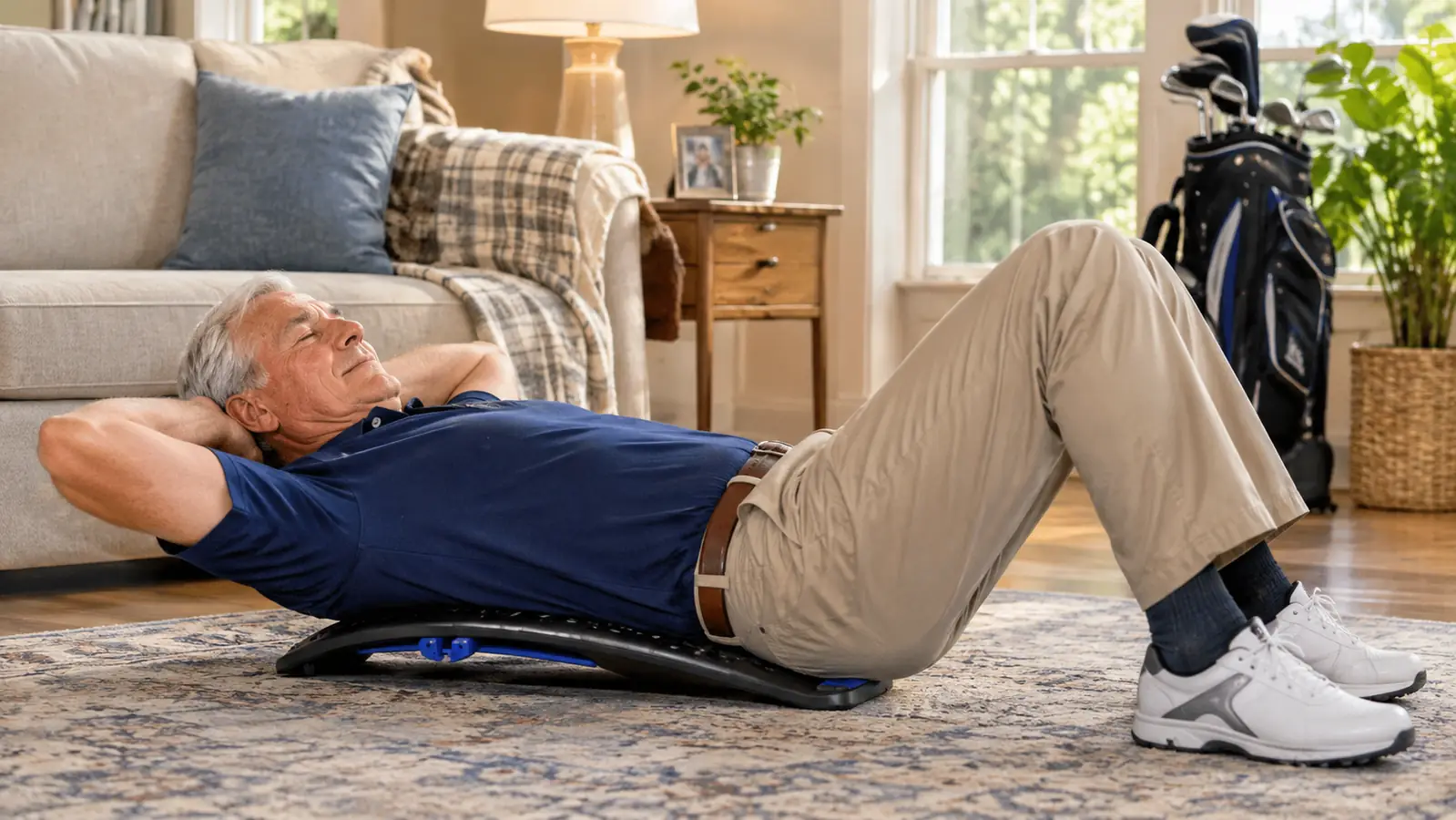
I am 61 years old, I carry a 16 handicap, and I have spent three seasons learning more about my lower back than I ever wanted to know. The stiffness started on a cold morning round when I was 58. It was a Tuesday league game in late February, the kind of morning where the frost was still on the fairways at nine o'clock. I finished the front nine, but by the turn I was moving like a man carrying a bag of concrete. My doctor called it muscular strain, plain lower back stiffness on my right side, and told me to stretch. So I stretched. I bought the Sparthos brace that spring, and it helped me get through the season, but it only held me together while I was wearing it. Ron at the course talked me into a TriggerPoint foam roller, and I used it off and on, mostly off. And about two years ago, after reading about lumbar extension, I ordered the MINOLL back stretcher. This is the honest version of that story: what it does, what it does not do, and what I wish somebody had told me before I bought it. I have no reason to sell you on this board and no reason to talk you out of it. I am just a golfer with a stiff back who has used the same piece of plastic for two years and figured out what it is good for.
The Quick Verdict
A solid, simple lumbar stretcher that helps me loosen up before a round and after a long ride in the cart. It will not fix a bad swing or a serious back problem, and the first few sessions are uncomfortable. If your back is just stiff, it is worth a look.
Amazon Check Today's Price →Stiff lower back before your tee time?
The MINOLL back stretcher lets you set the arch where it feels right and spend two minutes loosening up before you head to the first tee. Check today's price on Amazon.
Amazon Check Today's Price on Amazon →How I Have Used It
I keep the MINOLL in the spare bedroom I use for stretching, on the floor next to the foam roller. Most mornings I do a few minutes on it before coffee. On league days, Tuesday and Saturday, I use it again before I leave for the course, and sometimes for a couple of minutes when I get home, because sitting in the cart for 18 holes does my back no favors. The routine is simple: I set the arch at the angle that feels right, lie down on it so the curve sits under my lower back, and let my body settle for a minute or two. Then I stand up slowly and see how I feel. Some mornings I stand up and the stiffness is still there. Other mornings, usually the ones where I actually breathed into the stretch instead of rushing it, I can bend over and touch my toes for the first time since the night before.
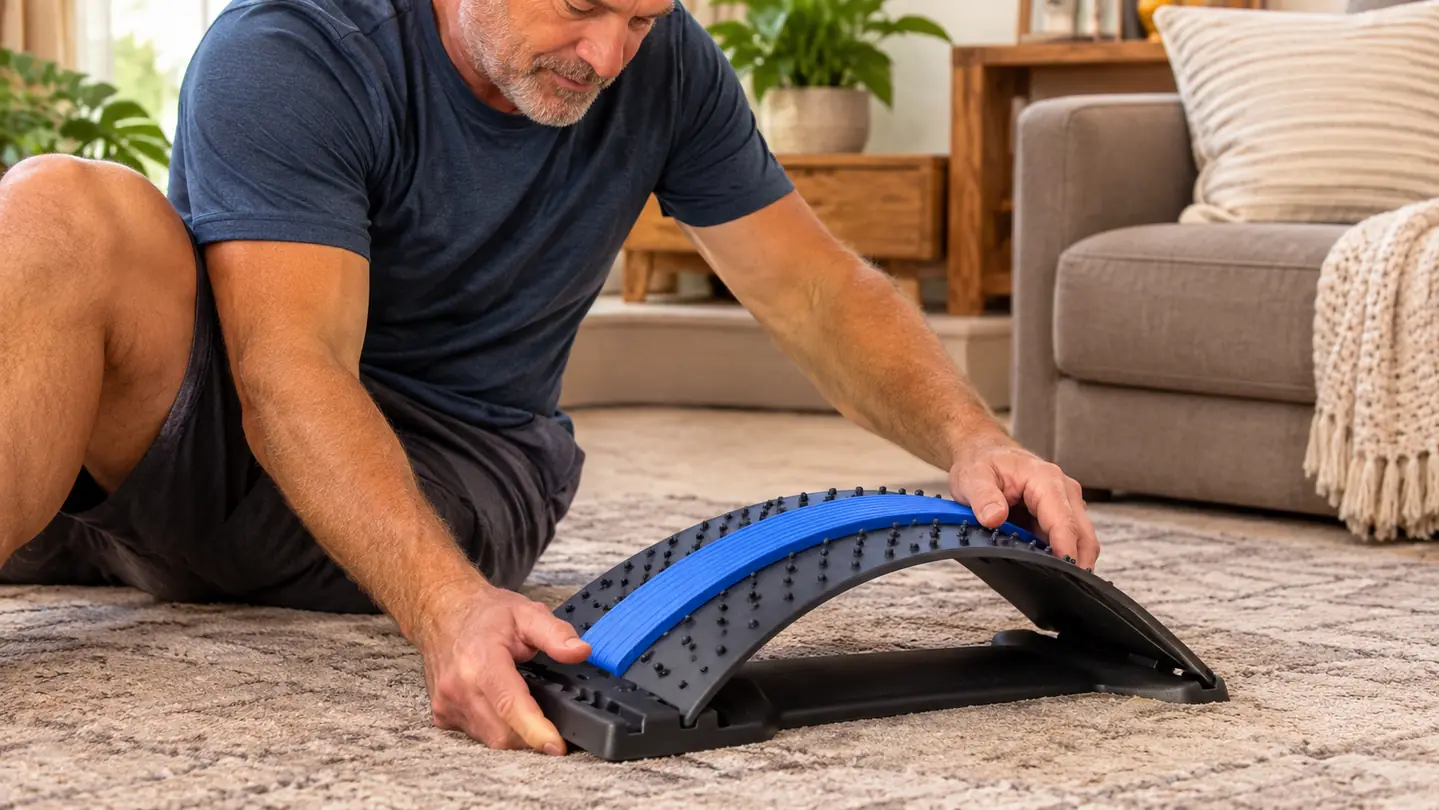
The board has three angle settings, 15 degrees, 28 degrees, and 42 degrees. I started at 15 and honestly thought I had wasted my money. It felt like lying on a very mild bump, the kind of thing you could almost forget was under you. I gave it a week at that setting, using it every morning, and it did not feel like much was happening. After about eight sessions I moved up to 28, which is where I have stayed for most of the two years. That setting puts a real, firm curve under my lower back, and it is the one that actually does something for me. The 42 degree setting is too much. I have tried it twice, once about a month in and once last winter, and both times I felt like I was asking my back to do something it was not ready for. I lasted about thirty seconds on it the second time before I rolled off and went back to 28. Maybe a younger man with a more flexible spine gets something out of it. I do not.
The whole thing weighs about 13.76 ounces and measures 15.16 by 9.84 by 1.57 inches, so it is easy to move from the spare room to the living room when I am watching NFL football on Sundays and stiffen up on the couch. It is made of ABS plastic and the company says it is tested to hold up to 400 pounds. I am not anywhere near that, so I cannot vouch for the limit, but it has never creaked or flexed under me. It has no moving parts to wear out, nothing to charge, nothing to assemble. I have thrown it in the car for a weekend trip more than once, and it takes up almost no room in a duffel bag.
What Nobody Tells You Before You Buy
Here is the part I did not see in any listing. The first time you lie on a back stretcher, it does not feel relaxing. It feels like a firm, strange pressure right in the spot that has been bothering you. I lay there for about twenty seconds, thought about getting up, and forced myself to stay for a full minute. That first session I set it at 15 degrees, the gentlest setting, and it still felt like someone had pressed a fist into my lower back. The next morning I was sore in a different way, the way a muscle feels after you have used it for the first time in years. It was not the sharp pain I get on the course. It was a deep, dull ache that told me something had actually been stretched. That is not a reason to avoid the product. It is a reason to start at the lowest setting and give your body a few sessions to catch up. I would say it took me about a week and a half before the board stopped feeling like a foreign object and started feeling like part of the routine.
The second thing nobody tells you is that this is not a passive fix. You do not lie on it and get a massage. You are actively stretching, and that means you have to breathe and relax into it. The first few times I held my breath and tensed up, which made the whole thing pointless. I would lie there for a minute, get up, and feel exactly the same as I did before. It was not until I stopped treating it like a chore and started treating it like a real stretch that it did anything. I have to remind myself to breathe slowly, let my hips sink toward the floor, and stay for a full two minutes. When I finally remembered to do that, the stretch actually started to feel good, the way a good hamstring stretch feels good once you stop fighting it.
The third thing is the one I want to be careful about. This is a stretch, not a treatment. The listing mentions a long list of conditions this board is marketed for, and I am not a doctor and I am not going to tell you that a curved piece of plastic can address any of them. My doctor told me I have muscular strain, plain lower back stiffness on my right side, and for that, this board helps me loosen up. It does not cure anything and it does not fix anything. It makes the stiffness less noticeable for a while, the same way a good warmup does. If your pain is sharp, radiating, or new, do what I did when mine first flared up at 58: talk to your own doctor before you buy anything. I am a retired HVAC contractor, not a medical professional, and the worst thing you can do is take stretching advice from a man whose main qualification is that he has a sore back and a 16 handicap.
The first time you lie on a back stretcher, it does not feel relaxing. It feels like a firm, strange pressure right in the spot that has been bothering you.
What It Actually Does for My Golf
I walk 9 and ride 18 most weeks, and the ride is the problem. Sitting in the cart for two hours tightens my right side in a way that walking never does. It is the same spot every time, that band of stiffness just above my hip, and it shows up around the 12th hole. On Saturdays, my group plays 18 and by the back nine I used to be reaching for my lower back after every tee shot. Since I started using the MINOLL before I leave the house, those first few swings feel freer. I am not going to claim it fixed anything, because it did not. I am going to say it made the first tee box more comfortable, and that matters when you are 61 and your warmup is three practice swings and a hope. There was one Saturday last fall, the first weekend in October, when I forgot to use it before I left. I realized it on the way to the course, shrugged, and played anyway. By the 14th hole I was doing the same old reach for the lower back after every tee shot. That was the most useful accidental test I could have run, because it told me the board was doing something real, not just something I wanted to believe.
I have also used it after a round, especially on the days when the stiffness does not show up until I am on the couch. Sunday is the worst for that. I play Saturday, I sit through church and then the NFL games, and by the fourth quarter my back has tightened up again. Ten minutes on the board, a glass of water, and I can usually get through the evening without walking like I just played 36. Karen has noticed the difference, which is saying something, because she does not golf and she has watched me complain about my back for three years. She is the one who actually suggested I use it on Sundays, after she got tired of watching me wince every time I stood up from the couch.
One honest note about swing mechanics: this board will not fix your golf swing. I bought the Orange Whip last spring to work on tempo, and that is a swing tool. The MINOLL is a stretching tool. It helps me show up to the course looser, but it does not add distance and it does not straighten my fade. If anything, I have to be careful not to expect too much from it. The first month I owned it, I convinced myself that a looser back would mean a freer turn, and a freer turn would mean I would finally stop leaving every approach shot short and right. That did not happen. My handicap is still 16, my fade is still there, and the only thing that changed is that I do not wince on the first tee anymore. If you are looking for a product that changes your swing, keep looking. If you are looking for something that makes your back feel better before you swing, this is a reasonable option.

The Pros and Cons After Two Years
After two years, here is where I land. I have used this board more than any other back product I own, including the brace and the foam roller. That alone tells you something, because I am not a man who sticks with a stretching routine. I have started and abandoned more of them than I can count.
What I Liked
- Three angle settings (15, 28, and 42 degrees) give you room to start easy and progress
- Light enough at about 13.76 ounces to move from room to room
- Simple to use with no assembly and no power source
- Helps me loosen up before a round and after a long ride in the cart
- Sturdy ABS build that has held up to two years of regular use
Where It Falls Short
- The first several sessions are genuinely uncomfortable
- The 42 degree setting is too aggressive for many older backs
- It is a stretch, not a treatment, and it will not address a serious back condition
- You have to be patient and breathe into it, which is harder than it sounds
- It does nothing for swing mechanics no matter what the marketing implies
Who This Is For
This is for the golfer over 50 whose back is stiff, not injured. The man who gets out of the cart after 18 holes and needs a minute before he can bend over to pick up his ball. The woman who wakes up on Saturday morning and does a few stretches before she loads her clubs. If your doctor has told you it is muscular, and you are looking for a way to loosen up before a round, the MINOLL is worth trying. Start at 15 degrees, breathe, and give it a couple of weeks before you judge it. I would also say this: if you are the kind of person who will actually use it, who will put it on the floor and lie on it for two minutes a day, you will get more out of it than the person who buys it and expects it to work while it leans against the wall. It is a tool, not a promise. The test I would give you is simple. If you have a spare two minutes in the morning and you are willing to spend them on the floor, this board will probably earn its place. If you are not, no stretcher on the market will help you.
Who Should Skip It
Skip it if your pain is sharp, radiating, or new. Skip it if you have a diagnosed condition in your spine and you have not cleared stretching with your doctor. And skip it if you are looking for a passive fix, because this board asks something of you. You have to lie down, relax, and breathe through the stretch. If that does not sound like something you will actually do, it will end up leaning against a wall in your spare room, and I say that with sympathy because I have a whole collection of things that ended up that way. I am not saying that to be clever. I am saying it because I watched myself almost do the same thing. The only reason the MINOLL did not end up in that pile is that I started slow, kept the expectations low, and used it on the days when my back actually needed it. If that sounds like you, it is worth a try. If it does not, save your money and spend it on a lesson instead.
Ready to loosen up before your next round?
The MINOLL back stretcher is simple, light, and has three arch settings so you can ease into it. Check today's price on Amazon and see if it fits your routine.
Amazon Check Today's Price on Amazon →