
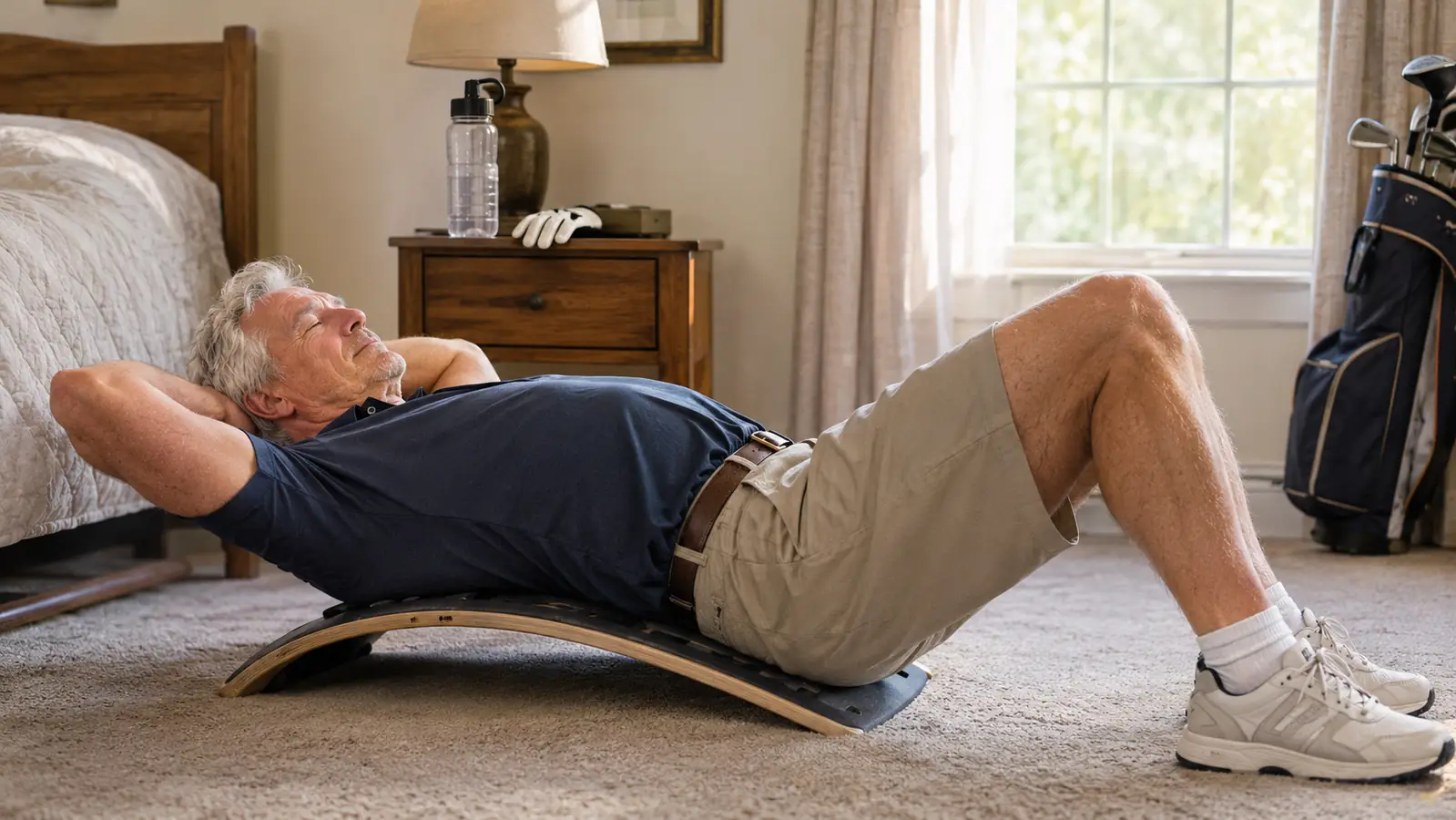
The first time I used a back stretcher, I was skeptical. I am 61, I play a Tuesday league round and a Saturday round most weeks, and my lower back has been stiff on the right side since a cold-morning round when I was 58. My doctor called it muscular strain. I have spent a lot of mornings since then deciding whether to play through it or skip the round. So when I ordered the MINOLL back stretcher about two years ago, I did not expect much. I expected a piece of plastic that would sit in the spare bedroom next to the foam roller. Instead, it became the thing I reach for on Sunday afternoons when I stiffen up on the couch watching football.
This is not a doctor's recommendation and I am not a physical therapist. It is one retired HVAC contractor's honest account of months of real use, what the MINOLL back stretcher did for my lower back, what it did not do, and who should probably skip it.
The Quick Verdict
The MINOLL back stretcher is the most useful piece of recovery gear I own. It does not fix a bad back, but it makes the next round noticeably more comfortable.
Amazon Check Today's Price →My lower back has felt looser before a round than it has in years
The MINOLL back stretcher is the thing I reach for on Sunday afternoons and the night before league day. Check today's price on Amazon and see if it belongs in your stretching routine.
Amazon Check Today's Price on Amazon →How I've Used It
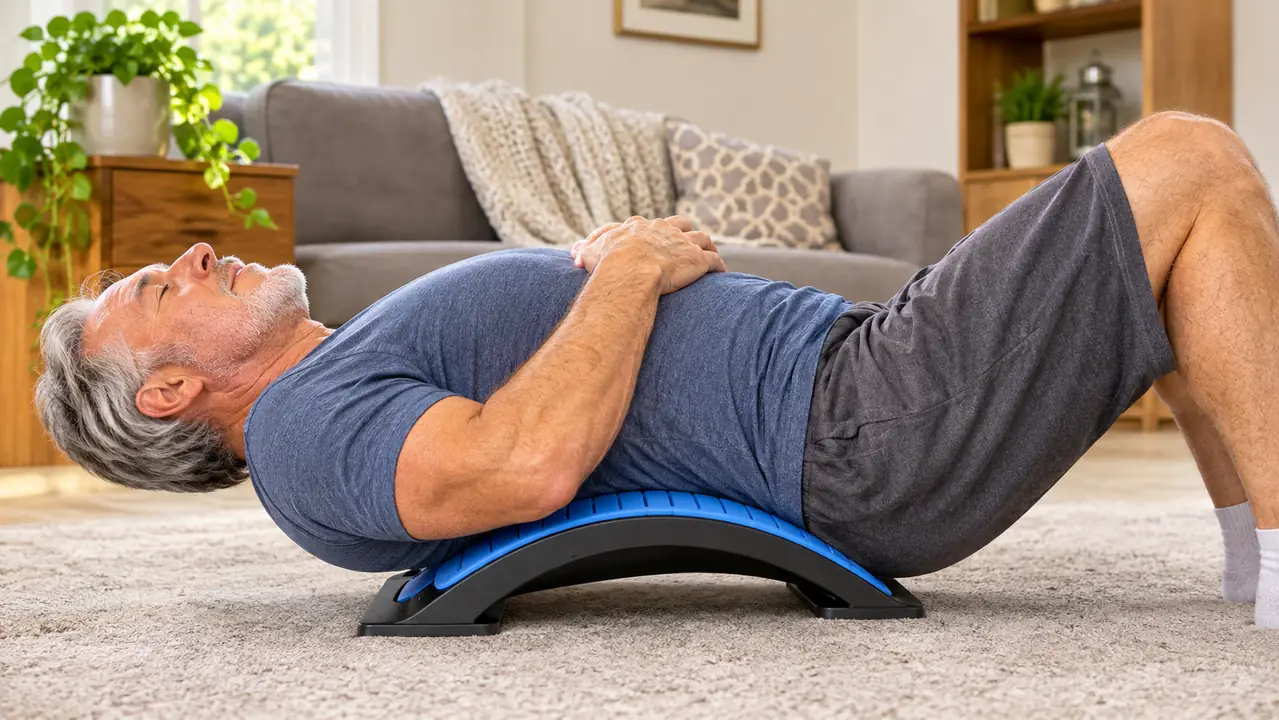
The MINOLL back stretcher is a curved board made of ABS plastic, about 15 inches long and 9.8 inches wide, and it weighs under a pound. You lie on your back with the arch under your lower spine and let your body weight do the work. The board has three angle settings: 15 degrees, 28 degrees, and 42 degrees. I started at 15 degrees for the first two weeks and honestly thought it was too gentle to matter. Then I moved up to 28 degrees and understood what people mean when they say a stretch finally reaches the right spot.
Those first two weeks taught me something the listing does not explain: position matters. The arch has to sit under the curve of your lower back, not up under your shoulder blades and not down on your tailbone. My first few sessions I had it too low, and I felt the stretch in my hips instead of my back. Once I found the right spot, which took maybe four sessions, the stretch changed completely. I also learned to keep my knees bent with my feet flat on the floor. That keeps my lower back relaxed instead of bracing against the board. And I learned to be patient. A back stretcher is not a massage. It is a position. The work happens slowly while you lie still, and for the first couple of weeks I nearly put it in the closet because nothing seemed to be happening.
Two years in, my routine is boring and consistent. I use the 28-degree setting for about five minutes the night before a Tuesday or Saturday round. On Sunday afternoons, after a round and a few hours on the couch watching NFL football, I do another five minutes on the same setting. I have used the 42-degree setting maybe a dozen times, usually on a Monday morning when the right side feels especially tight. It is a stronger stretch and I do not stay on it as long.
I keep the MINOLL on the floor of the spare bedroom I use for stretching. It takes up almost no space, which matters in a house where the garage already has a hitting net and the bedroom has a foam roller and a heating pad. The whole session is five minutes. There is no setup, no straps, no inflation, no batteries. You lie down, find the angle, and let the board hold you.
What the Three Angles Actually Feel Like
The multi-level adjustment is the feature that sold me, and it is the feature I would miss most if I switched to a different board. At 15 degrees, the MINOLL feels like a gentle reminder to your spine. It is a fine starting point, especially if you have never used a back stretcher before, but after the first week I stopped feeling much from it. At 28 degrees, the arch sits under my lower back in a way that produces a series of small, satisfying releases. That is the setting I use 90 percent of the time.
I should also be honest about what the release feels like, because the listing calls this a back cracking device. For me it does not crack like knuckles. It is more of a slow opening, a series of small pops and releases that happen over a few minutes as the muscles along my spine let go. Some days there is nothing audible, just a sense of the arch pressing into the right spot. The days I feel the most releases are the days I need it most, usually after a long car ride or a full afternoon on the couch.
The 42-degree setting is the one I approach with respect. The first time I tried it, I lasted about ninety seconds. It felt like someone had folded me backward over a fence post. I got up, walked around the bedroom, and told myself I would come back to it. The second time was easier, and by the fourth or fifth session I could do three minutes. I still do not use it the night before a round. That deep of a stretch leaves my back feeling loose but a little tired on the first tee. I save it for Monday mornings, when I have two days before the Tuesday league round and the right side has had a full weekend of sitting and driving to tighten up. The MINOLL listing says the board is tested to hold up to 400 pounds, and I believe it. I am not a small man and the board has never flexed, creaked, or felt unstable under me, even at the steepest angle.
The 28-degree setting produces a series of small, satisfying releases in my lower back. That is the setting I use 90 percent of the time.
How It Held Up Over Months of Use
I have owned the MINOLL back stretcher for about two years, which means it has survived roughly 200 league rounds, a few dozen Sunday football marathons, and one incident where I dropped it on the tile floor in the bathroom. The ABS plastic has no cracks, the angle settings still click into place firmly, and the surface still has enough grip that I do not slide when I lie on it. For a piece of gear that costs less than a round of golf at a nice course, the build quality has impressed me.
One detail I did not expect to care about is how relaxed I can stay on the board. I have used a friend's back stretcher where I spent the whole session tensing up to keep from sliding toward the floor. With the MINOLL I can actually let my weight settle and breathe into the stretch. It also wipes clean with a damp cloth, which matters on summer Saturdays when I come home from the course still a little sweaty.
The angle adjustment has been through hundreds of sessions, and after two years it still locks where I set it. There is no wobble when I shift my weight onto it and no drift while I lie there. I have had cheap plastic gear fail in less than a season, and this board has not given me any reason to replace it. The only visible sign of age is a few light scuffs on the underside from being moved around the house.
The honest tradeoff is that it is a single-purpose tool. It does one thing: it arches your lower back over a fixed curve. It does not massage, it does not vibrate, it does not wrap around you, and it will not replace a heating pad or a foam roller. I use all three, and they do different jobs. The heating pad loosens me up, the foam roller works the muscles on either side of my spine, and the MINOLL gives my lower back the extension that neither of the other two provides.
What It Did for My Golf
I carry a 16 handicap and I am honest with myself about my swing. The MINOLL did not fix my swing, lower my scores, or add ten yards off the tee. What it did was make the first few holes feel better. Before I started using it, the first tee box was the worst part of the day. My lower back felt stiff and I would take two or three holes to loosen up. Now, after five minutes on the 28-degree setting the night before, I walk to the first tee feeling like I have already warmed up.
There was one Saturday round that convinced me the routine was worth keeping. It was late September, and the temperature had dropped into the sixties overnight. Cold mornings are exactly what set my back off in the first place. I did my five minutes on the 28-degree setting before I left the house, and I walked to the first tee expecting the usual stiffness. It never showed up. I hit my first drive without wincing, shot a 44 on the front nine, and my playing partner Ron asked what I had changed. I told him about the MINOLL. He laughed and said he would stick with his foam roller, and we both played the whole round. That is the point. I am not trying to convert anybody.
The other change is on Sunday. I watch NFL football after my round, and sitting on the couch for three hours used to leave me stiff and sore by the evening. Now I do five minutes on the MINOLL when I get home and I do not spend the evening shifting around trying to find a comfortable position. That alone has made it worth the money.
I will say the Sunday routine took longer to become a habit than the pre-round one. For the first few weeks I would come home from the round, sit down to watch football, and tell myself I would stretch at halftime. Halftime would come and go. Now I do the five minutes before I even sit down, while I am still in my golf clothes. It takes less time than making a pot of coffee, and it means I can enjoy the second half without shifting around on the couch every few minutes.
Who This Is For
The MINOLL back stretcher is for you if you have the same kind of lower back stiffness I do: a dull soreness that shows up after sitting, after a round, or the morning after a long day, and that loosens up as you move. It is for people who want a five-minute stretch they can do at home without a class, a trainer, or a gym membership. It is for golfers who are tired of spending the first three holes trying to feel human.
It is also for people who like adjustable gear. The three angles mean you can start gentle at 15 degrees and work up to 28 or 42 degrees as your back gets used to the stretch. That is a real advantage over a one-size-fits-all board. And at under a pound, it is easy to move from the bedroom to the living room, or to take along if you travel.
Who Should Skip It
You should skip the MINOLL back stretcher if your pain is sharp, radiates down your leg, or came on suddenly. I am not a doctor, and neither is the Amazon listing. My own doctor told me my back issue was muscular strain, and I only started using a back stretcher after he cleared me. If your pain is new, sharp, or radiating, talk to your doctor before you lie down on any curved board. This is not a medical device and it will not fix a disc problem, a nerve problem, or anything a doctor has not looked at.
You should also skip it if you want a tool that does several jobs. The MINOLL is a back stretcher and nothing else. It will not massage your shoulders, it will not work your neck, and it will not replace the foam roller that already lives in my stretching room. If you want one piece of gear that does everything, buy a foam roller and a heating pad instead.
And if you are the kind of person who buys recovery gear and never uses it, this will not be the exception. It only works if you lie on it. Five minutes, a few times a week, for months. The MINOLL has helped me because I use it, not because it is magic.
What I Liked
- Three adjustable angles (15, 28, and 42 degrees) let you start gentle and progress
- Lightweight ABS board, about 13.8 ounces, easy to move and store
- Tested to hold up to 400 pounds, and it has never flexed under me
- Five-minute sessions fit easily into a routine
- No assembly, no batteries, no setup
Where It Falls Short
- Single-purpose tool: it only stretches the lower back
- The 42-degree setting is intense and takes time to work up to
- Does nothing for sharp or radiating pain, and is not a medical device
- The 15-degree setting stopped feeling useful after the first couple of weeks
Five minutes on the 28-degree setting is the closest thing I have to a pre-round warmup
If your lower back stiffens up after a round or a long day of sitting, the MINOLL back stretcher is worth a look. It helped me, and I am picky about recovery gear. Check today's price on Amazon.
Amazon Check Today's Price on Amazon →