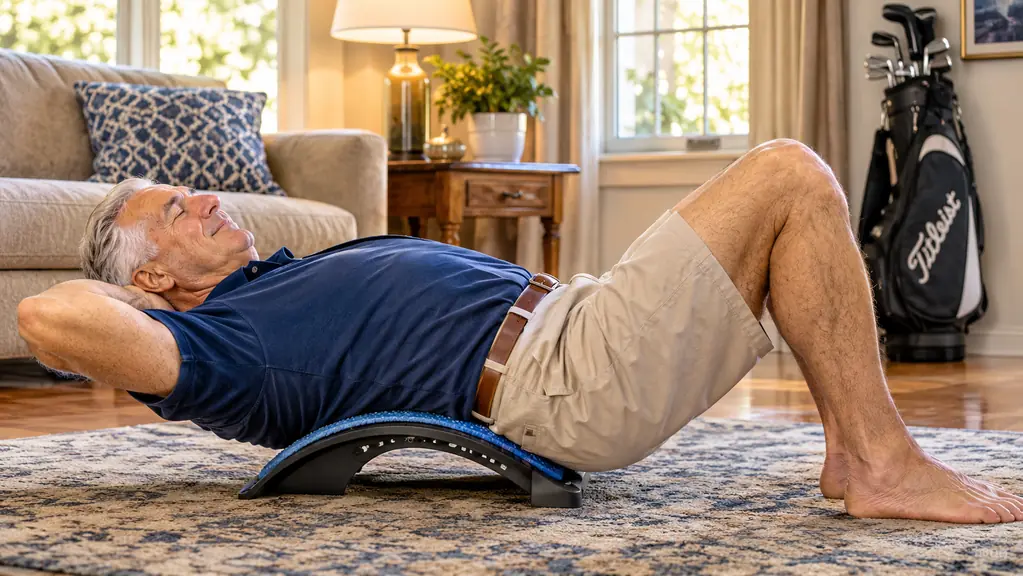
If your lower back stiffens up on the back nine the way mine does, you have probably looked at the same two things I did: a curved back stretcher you lie on at home, and a lumbar traction belt you strap on before you play. I am Gary Lindqvist, 61, a retired HVAC contractor in Mesa, Arizona, and my lower back has been stiff on the right side since a cold-morning round when I was 58. My doctor called it muscular strain, no surgery, no disc injury, just a back that complains when I sit too long or ride the cart too much. I have owned the MINOLL back stretcher for about two years, ordered it myself after reading about lumbar extension, and it lives on the rug in my spare bedroom. A friend on my Tuesday league wears a lumbar traction belt under his shirt every round, and last month I borrowed his, wore it for a few holes, and compared it directly against the stretcher I use at home. I also took a few practice swings into the hitting net in my garage wearing the belt, because that is where I test anything that claims to help my swing. The belt stayed put, but it felt like a brace more than a stretch. Short answer: they are not competing tools. The MINOLL fits a golfer who can spend ten quiet minutes on the floor before a round. A lumbar traction belt fits a golfer who needs support while he walks the course. For my routine, for my particular stiff right side, the MINOLL won. But I want to show you exactly why, because the right answer depends on how your back behaves, not on mine.
Here is the honest version of my test. I am a 61-year-old golfer, not a medical professional, and I am not going to tell you that either tool will fix your back. What I can tell you is how each one felt on my back, how often I actually reached for it, and where each one let me down. That is the comparison you are really asking for.
| MINOLL Back Stretcher | Lumbar Traction Belt | |
|---|---|---|
| What it does | You lie on a curved board and let your lower back settle into extension at 15, 28, or 42 degrees | A belt you wear around your lower back, inflated or tightened to take load off the lumbar area while you move |
| When you use it | Ten minutes at home, before the round or after you walk in the door | On the course, under your shirt, while you walk or play |
| Weight and size | 15.16 x 9.84 x 1.57 inches and 13.76 ounces, easy to keep in the spare bedroom | Lightweight and packs into a golf bag, but you have to put it on and take it off |
| Best for | A stiff lower back that loosens up with a few minutes of gentle extension | A lower back that needs support and compression while you stand, walk, and swing |
| Learning curve | Three angle settings and a 400-pound weight limit, so you find your level and stay there | You have to learn how tight to make it, and it can shift during a swing |
| Portability | Stays at home, which means you actually use it before every round | Goes wherever you go, but it is one more thing to remember |
Where MINOLL Wins
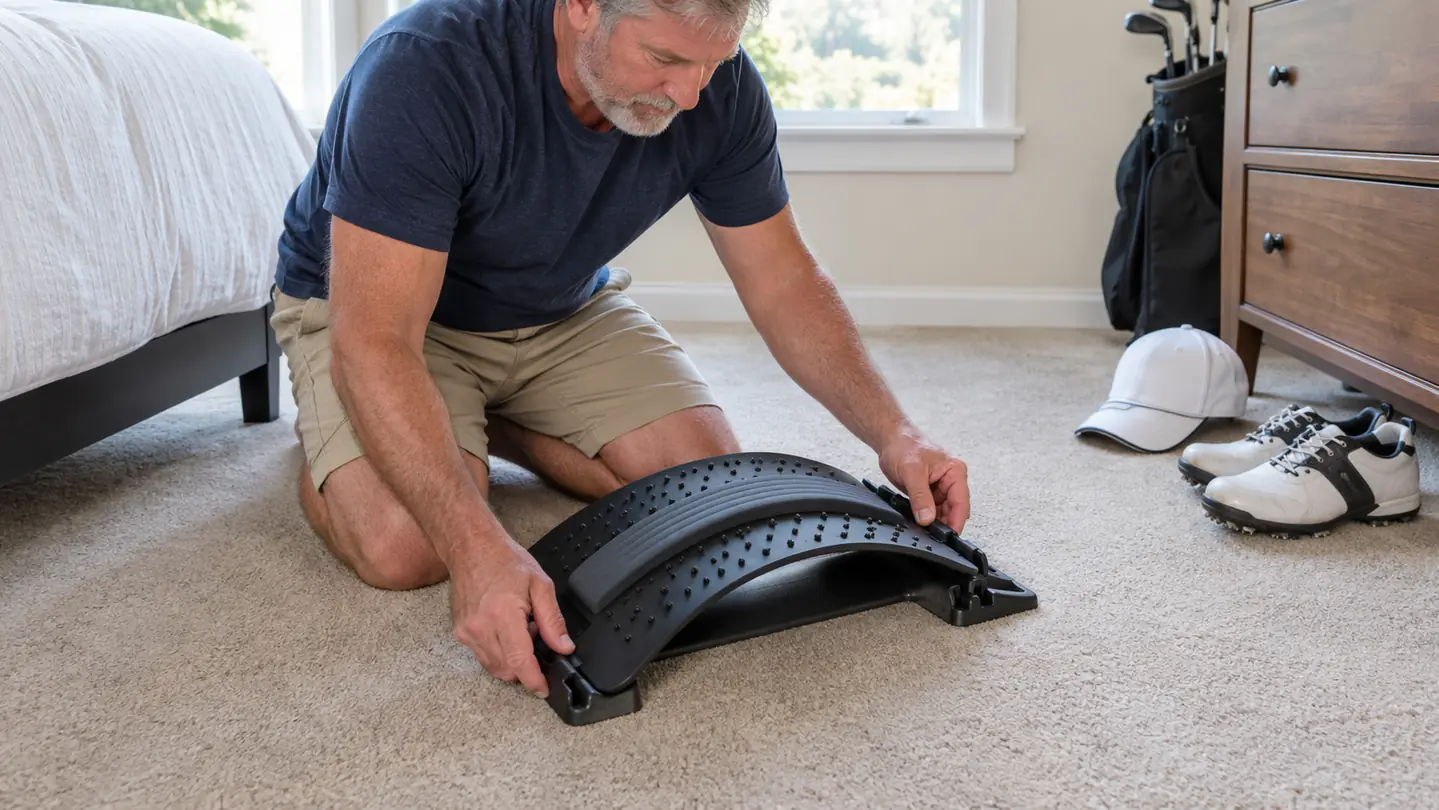
The MINOLL wins for me because it fits the way my back actually behaves. My lower back stiffens on the right side after a cold morning, after a long ride in the cart, and especially on Sundays when I sit through the NFL game after my round. The MINOLL is a curved board, 15.16 by 9.84 by 1.57 inches and 13.76 ounces, with three angle settings: 15 degrees, 28 degrees, and 42 degrees. The surface uses an upgraded ergonomic design that increases the contact area against your back, and the frame is ABS, the same kind of plastic I handled in tool housings for thirty years in the HVAC trade, so it feels solid under me. The listed weight limit is 400 pounds, which I will never test, but it tells me the board is not going to flex when I lie down. My routine is the same every Tuesday: I get to the course about twenty minutes early, spend ten of those minutes on the floor in the spare bedroom, start at the lowest setting, and let my back settle. I do not bounce on it and I do not try to force anything. I just lie there, knees bent, and breathe. It does not crack anything and it does not fix anything. It gives my lower back a sustained stretch I cannot get standing up, and I walk to the first tee noticeably looser. The first time I used it, about two years ago, I lay down for a few minutes, got up, and realized I had not felt that particular looseness in months. That is what sold me.
The traction belt cannot do that. It supports your back while you move, but it does not give you the same sustained stretch. I borrowed my friend's belt on a Saturday, wore it for the first few holes, and it felt fine, genuinely fine, but I had to stop and adjust it twice, once after a practice swing and once on the way to the second green, and I never got the loosened-up feeling I get from ten minutes on the MINOLL. The MINOLL is also simpler to use correctly. There is no guessing how tight to make it. You pick an angle and you lie down, and the board holds that angle for you. I started on the 15-degree setting for the first month I owned it, moved up to 28 degrees once my back got used to the position, and I have stayed there since. The 42-degree setting is there if I ever want it, and the height-adjustable design means I have a range to grow into. I keep mine on the rug in the spare bedroom, so it is already out when I need it. At 13.76 ounces it is light enough to move, but I never do. It lives where I stretch, and because it lives there, I actually use it before every round instead of remembering to pack it. On Saturdays I do the same thing before I meet my friends, and on Sundays, when I stiffen up on the couch watching football, I will pull it out in the second half and lie on it during the commercial break.
Where the Lumbar Traction Belt Wins
I will be honest with you: the belt wins the portability argument, and for some golfers that is the only argument that matters. My Tuesday league friend wears his belt under his shirt for the whole round, and he walks 18 while I walk 9 and ride 18. He says the support keeps his lower back from tightening up by the turn, and I watched him play a full round on a day when I was stiff by the 12th. He was fine. I cannot argue with that. He has played that way for two seasons now, and he says he will not go back to playing without it. If your back bothers you while you are standing over a putt, or when you are walking a hilly course, a traction belt puts the support exactly where you need it, when you need it. The MINOLL cannot do that. It is waiting for you at home, but it is not on the course with you. And here is what I have to admit: on the day I borrowed the belt, my back did not tighten up the way it usually does by the turn. The support worked. It just worked in a different way than the stretcher works, giving me something to lean on during the round instead of loosening me up before it.
The belt also wins if you do not have ten quiet minutes before a round. I play a Tuesday league and a Saturday game with friends, and I can usually get to the course early enough to stretch. Not everyone can. If you are racing from work to the first tee, or if your league starts before you can get there, strapping on a belt takes less than a minute, and you can adjust it as you play. That is a real advantage, and I do not want to wave it away. The tradeoff is that a belt is one more thing to remember in the bag, one more thing to adjust, and one more thing that can shift when you swing. I had to stop twice in four holes to reposition my friend's belt, and I was not even swinging hard. I tried the belt on a Tuesday too, not just a Saturday, and the result was the same: it helped during the round, but it never gave me the loosened-up start that the stretcher does. For me, the ten minutes on the MINOLL is worth more than the on-course support, because my problem is mostly stiffness that builds up overnight and in the car, not pain that flares while I am standing over the ball. But I understand the golfer who chooses the belt. If your back complains during the round itself, the belt is doing a job the stretcher simply cannot do from the spare bedroom.
The stretcher that made my Tuesday rounds more comfortable
I have used the MINOLL back stretcher for two years and it still earns its spot on the spare bedroom rug. If your lower back stiffens up before a round, this is the tool I reach for.
Amazon Check Today's Price on Amazon →The belt supports you while you walk. The MINOLL loosens you up before you swing. I know which one I reach for on a Tuesday morning.

Who Should Buy Which
Buy the MINOLL back stretcher if you are like me: your lower back stiffens up overnight or after sitting, and ten minutes of lying on a curved board before a round makes the first tee feel better. It is also the better choice if you want something simple, with no straps to adjust and no learning curve beyond picking one of three angles. I use the 15-degree setting when I am just a little stiff, the 28-degree setting when I have sat through a long car ride or a Sunday of football, and I have never needed the 42-degree setting, but it is there if my back ever asks for more. The board is built to hold up to 400 pounds, so I never think twice about using it, and at 13.76 ounces I can carry it from the spare bedroom to the living room if I want to stretch while Karen watches TV. I have had mine for about two years, and it has not cracked, flexed, or worn out. It is the same board I ordered after reading about lumbar extension, and it still does the same job every Tuesday and Saturday. The only maintenance it needs is an occasional wipe-down with a damp cloth, which takes about ten seconds.
Buy a lumbar traction belt if you need support while you are actually playing, especially if you walk 18 and feel your back tighten by the back nine. That was my friend's situation, and the belt made his rounds more comfortable in a way the MINOLL never could, because the MINOLL is at home when he is on the course. The belt is also the better choice if you cannot get to the course early enough to stretch, or if you play in a league where you walk straight from the car to the first tee. And if your doctor has told you to avoid lying flat on your back, skip the stretcher and talk to them about a belt instead. I am not a doctor and I am not a physical therapist. I am a 61-year-old golfer with a 16 handicap who found that the MINOLL made my Tuesday and Saturday rounds more comfortable. If your pain is sharp, radiating, or new, check with your own doctor before you buy either one. What worked for me is a stretch on the floor before I play. What works for my friend is support while he plays. Both are legitimate. The question is which one matches your back. If you are not sure which one you are, that is exactly the conversation to have with your doctor before you spend money on either.
Ten minutes on the floor beats a stiff back on the first tee
The MINOLL back stretcher is the tool I have used for two years, and it is the one I would buy again. Check today's price on Amazon and see if it fits your routine.
Amazon Check Today's Price on Amazon →