

I used to be able to play eighteen holes on a Saturday and feel nothing on Sunday. Somewhere around fifty-eight that changed, and it changed on a cold Tuesday morning in February. I finished the front nine, bent over to pick up my tee, and my lower back said no. I spent the rest of that season either skipping rounds or playing through a stiffness that made the last four holes miserable.
My doctor called it muscular strain, plain and simple, and told me to keep moving and stretch more. The problem was that I did not know how to stretch a lower back that was already sore. I tried touching my toes. I tried lying on the floor. I tried the foam roller a buddy named Ron recommended on the course. Some of it helped a little. None of it got me loose fast enough to matter. About two years ago I read about lumbar extension and ordered a MINOLL back stretcher, and it changed the order of everything I do after a round. This is the exact routine I use now, in the order I use it.
The MINOLL Back Stretcher Is the Board I Reach For After Every Round
It is the piece of gear that finally made my post-round stretching routine stick. The three-level arch lets me start gentle and work deeper as my back loosens, and it takes about ten minutes a day.
Amazon Check Today's Price on Amazon →Step 1: Give Yourself Ten Minutes Before You Do Anything Else
The biggest mistake I made for years was treating post-round stretching like something to squeeze in before dinner. I would rush it, skip it, or do it in front of the TV while the game was on, which meant I was not actually paying attention to what my back was telling me. Now I block out ten minutes the moment I get home, before I sit down on the couch, before I grab a drink, before I do anything else. Karen knows not to talk to me during it, and she also knows it is the reason I am not useless the rest of the day.
The reason the timing matters is that your back is warmest right after a round. You have spent four hours swinging, walking, and bending over putts, and that warmth makes the tissue more willing to lengthen. If you wait until Sunday morning, when you have stiffened up overnight, you are starting from a much harder place. Ten minutes on Saturday beats an hour on Sunday.
What finally made it stick was putting the MINOLL in the spare bedroom instead of the garage. When it lived on a shelf next to the hitting net, I told myself I would use it after I unloaded the clubs and put the bag away. That never happened. Moving it to the room I walk through on the way to the shower meant I passed it before I could talk myself out of it. The first time I used it there, I set a timer on my phone for ten minutes, and I have done the same thing every round since.
Step 2: Start on the Floor with Your Knees Bent
Before I put any arch under my back, I spend two or three minutes on the floor with my knees bent and my feet flat. This is not the stretch. It is the warm-up for the stretch, and it gives my lower back a chance to settle into a neutral position after four hours of rotation and bending. I lie there, breathe slowly, and let the stiffness start to talk to me. If it is sharp, I stop and call it a day. If it is just tight, which is what it usually is, I move on to the next step.
This is also the point where I decide which level I am going to use on the MINOLL. The board has three settings, 15 degrees, 28 degrees, and 42 degrees, and I have learned not to be a hero about it. A cold back gets the 15-degree setting. A back that has been stiff for two days gets the 15-degree setting too. The 42-degree setting is for the days when I am already pretty loose and just want to open things up a little more.
I learned that lesson the hard way on a Saturday in April. I had skipped the warm-up, set the board to 28 degrees, and lay down right after the final putt. My back did not loosen up. It tightened up, and I spent the evening on the couch with the RENPHO pad instead of watching the game comfortably. Ron, who has had his own back troubles, told me the next Tuesday that he makes the same mistake every spring. Now I do the warm-up even when I feel fine, because the warm-up is what tells me whether I actually feel fine.
Step 3: Lie on the Board and Let the Arch Do the Work
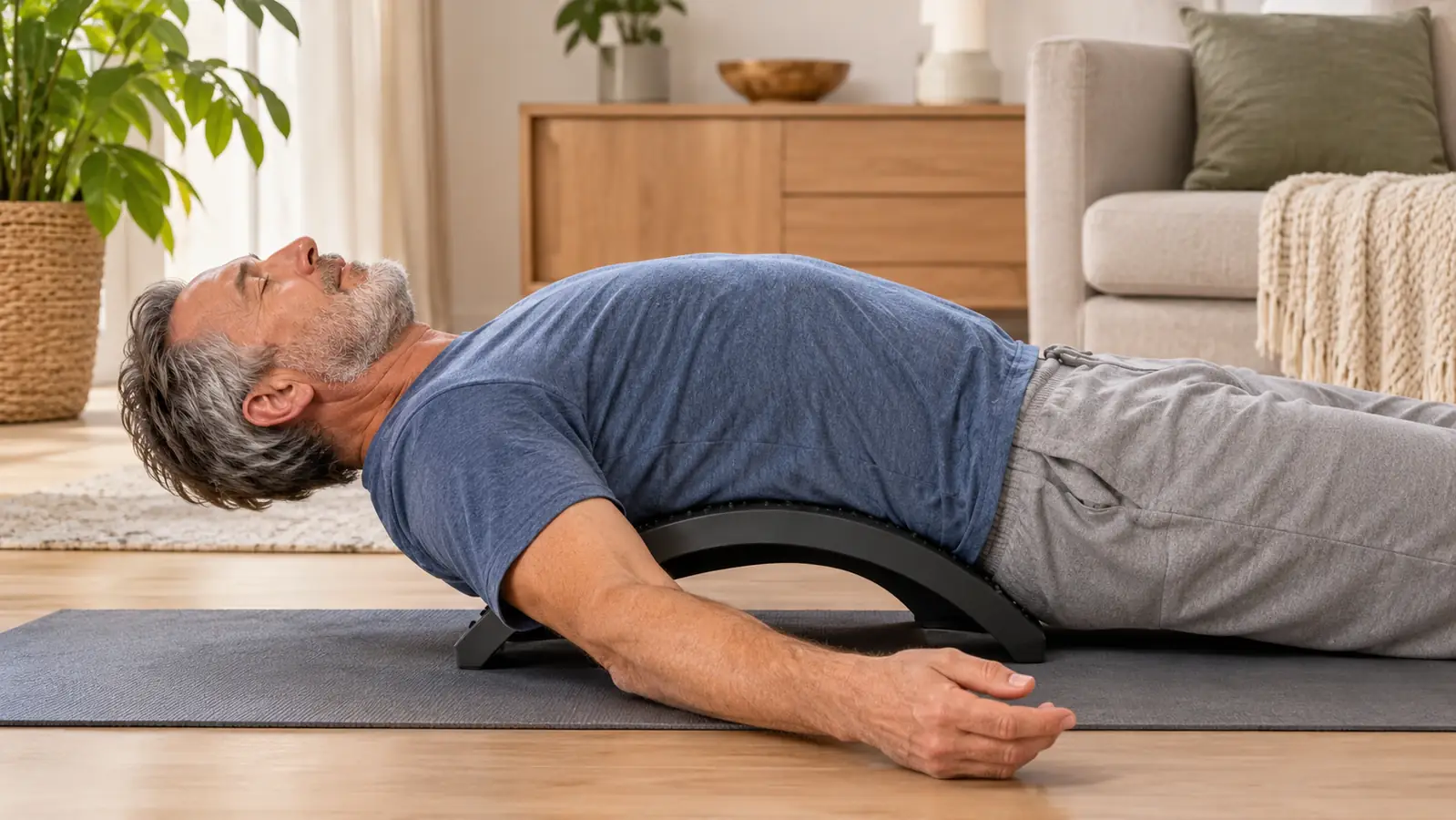
I place the MINOLL on a flat, carpeted part of the floor, lie down on it so the arch is under my lower back, and bend my knees so my feet stay flat. Then I do the hardest thing in this entire routine: nothing. I do not push. I do not bounce. I do not try to force my spine into a deeper position. I just lie there and breathe while the board holds my back in a gentle extension.
The board is made of ABS plastic, and it is light enough that I can carry it from the spare bedroom to the living room without thinking about it. It measures about 15 by 10 inches, so it stores flat against the wall in the spare bedroom. It is rated to hold up to 400 pounds, which is not something I need to worry about, but it tells you the thing is built. I start with two minutes on the 15-degree setting. As my back loosens over the course of the season, I will sometimes work up to the 28-degree setting, but I rarely go beyond that on a golf day.
The first time I used it, I made the mistake of staying on for ten minutes and then standing up too fast. My back felt worse, and I blamed the board. The truth is I used it wrong. The right way is shorter sessions, slower transitions, and more consistency. Two minutes a day, every day, beats ten minutes once a week.
On a normal Tuesday league round, I do two minutes and then get up. On a Saturday when I have walked all eighteen, I give myself three minutes, but I break it into two sessions of ninety seconds with a short pause in between. That pause is the part I never see mentioned on the product page, and it matters. Getting off the board, standing for a few seconds, and lying back down resets the position of the arch so the stretch does not sit in the exact same spot the whole time.

Step 4: Roll Out the Sides Before You Stand Up
This is the step I added after realizing that the board alone was not enough. The MINOLL stretches the lower back in extension, but a round of golf also leaves the muscles on the sides of my back tight, and the board does not reach those. So before I stand up, I spend a few minutes on the floor with the TriggerPoint foam roller Ron told me about, working along the sides of my back and into my glutes.
I keep it gentle. A foam roller can be a weapon if you use it wrong, and I have seen guys in the locker room put their full body weight on one and call it recovery. I do not do that. I roll slowly, stop on the spots that feel tight, and breathe into them for twenty or thirty seconds. Then I roll a little more. The whole thing takes about three minutes.
The order matters more than I expected. For the first month I rolled first and used the board second, because the roller felt like the more active treatment. But rolling first left the deeper muscles loose while the surface muscles were still tight from the round, and the board then put pressure on spots that were not ready for it. Swapping the order, board first and roller second, let the board do its job on the muscles that were ready, and the roller finished the spots the board cannot reach. That one change made the whole routine feel steadier.
Step 5: Stand Up Slowly and Walk It Off
The way you get off the floor matters more than you think. If I roll to my side, push up with my hands, and stand up like a normal person, my back complains. If I roll to my side, pause, push up to my hands and knees, pause again, and then stand up slowly, my back barely notices. That extra ten seconds is the difference between walking into the house feeling loose and walking into the house feeling like I just made things worse.
After I am standing, I take a short walk around the house, usually to the kitchen and back, just to let everything settle into place. Then I sit down, put my feet up, and watch the rest of the football game without wincing every time I shift position. Sundays are the real test. I play Saturday, stretch Saturday, and if I can sit through the early games on Sunday without my right side locking up, the routine worked.
What Else Helps
The MINOLL is the centerpiece of my routine, but it is not the only thing in it. The RENPHO heating pad Karen gave me for Christmas two years ago is what I reach for on the evenings when my back is still tight after the stretching. Twenty minutes of heat on the low setting, usually while I am reading, takes the edge off in a way that the board alone cannot. The Orange Whip swing trainer in the garage is less about recovery and more about prevention, since a smoother tempo means fewer bad swings that leave my back sore in the first place. And the Sparthos back brace still lives in my golf bag for the cold mornings when I want a little extra support on the front nine. None of these things fixed anything. Together, they made rounds more comfortable and Sundays a lot easier.
If you are going to try this routine, give it two weeks before you judge it. The first few times, the board will feel strange and you will not be sure anything is happening. Somewhere around the third round, you will notice that you are not dreading the walk from the car to the front door. That is the moment the routine becomes worth keeping.
The right way is shorter sessions, slower transitions, and more consistency. Two minutes a day, every day, beats ten minutes once a week.
Start Your Own Post-Round Routine Tonight
You do not need a gym membership or a physical therapist to stretch your lower back after golf. You need a flat piece of floor, ten minutes, and a board that puts your back in a gentle arch. The MINOLL is the one I have used for two years.
Amazon Check Today's Price on Amazon →