

If your swing feels like it has a stutter in it, you already know the feeling. The club gets to the top, then everything rushes, your hands fire first, your hips lag behind, and the ball squirts off to the right. I spent a whole season fighting that exact thing. My back was stiff on the right side, my tempo was shot, and I was dreading Tuesday league instead of looking forward to it.
I am 61, a retired HVAC contractor in Mesa, Arizona, and I carry a 16 handicap on a good week. I am not a coach and I am not a physical therapist. I am just a guy who needed a way to smooth out his swing without driving anywhere, and I found one that worked. This is the exact five-step routine I have done in my garage for the last few months, built around the Orange Whip swing trainer.
The trouble started on a cold December morning when I was 58. I was playing with the Saturday group and we were running late, so I skipped my usual warmup. By the third hole, my right side was locking up on every swing. I finished the round, but I paid for it for a week. My doctor called it muscular strain, no disc damage, and told me to stretch more. I did stretch more, but I also started swinging defensively, protecting my back instead of turning through the ball. That is when the stutter showed up, and it took me a full season to understand the two were connected.
Before I found this routine, I tried a lot of things. I kept a heavier weighted club in the garage and swung it until my forearms ached. I watched tempo videos and tried counting in my head. I even tried a metronome app on my phone, but the beeping made me rush worse. None of it stuck, because none of it showed me the feeling I was missing. The Orange Whip is the first thing that did, and the five steps below are exactly what I do with it in my garage.
Want the same 15-minute garage routine?
The Orange Whip is the training aid I use for every step of this routine. It is a patented, American-made swing trainer with a flexible graphite shaft and a weighted head, and it has been the number one rated golf teaching and training aid for a reason. Check today's price on Amazon before you start.
Amazon Check Today's Price on Amazon →Step 1: Loosen the right side before you swing
I do not start with full swings. I start with the Orange Whip resting across the back of my shoulders, both hands holding the shaft near the ends, and I do slow turns left and right. Ten reps each side, no rush. The weighted head hangs out past my hands, so even a small turn gives my lower back a gentle stretch it does not get from standing still.
This matters more than it sounds like it should. My stiffness is always worse on the right side, and if I skip this step, my first real swing of the day feels like it is fighting me. Two minutes of turning with the trainer on my shoulders changed that completely. If you have lower back trouble, do not skip this. If the pain is sharp or new, check with your doctor first.
I learned this the hard way on a Tuesday last spring. I came home from the hardware store, my back already tight from the morning, and I told myself I would just hit a few balls into the net without the warmup. The first swing felt like a knot in my side, and I spent the rest of the week fighting it. Now I do the shoulder turns first no matter what. If I have time for nothing else, I do this step, because a loose right side is the difference between a smooth round and a stiff one. Karen has watched me do it enough times that she knows something is off if I skip it.
Over the first few weeks, the shoulder turns did more than loosen me up. They taught me where my range of motion actually ends. I found out my right side was turning noticeably less than my left, which explained why my backswing always felt different depending on which way I was coiling. Now I use the turns to check that both sides feel equal before I pick up a real club. That check has become as routine as tying my shoes, and it takes less than two minutes.
Step 2: Find the pause at the top
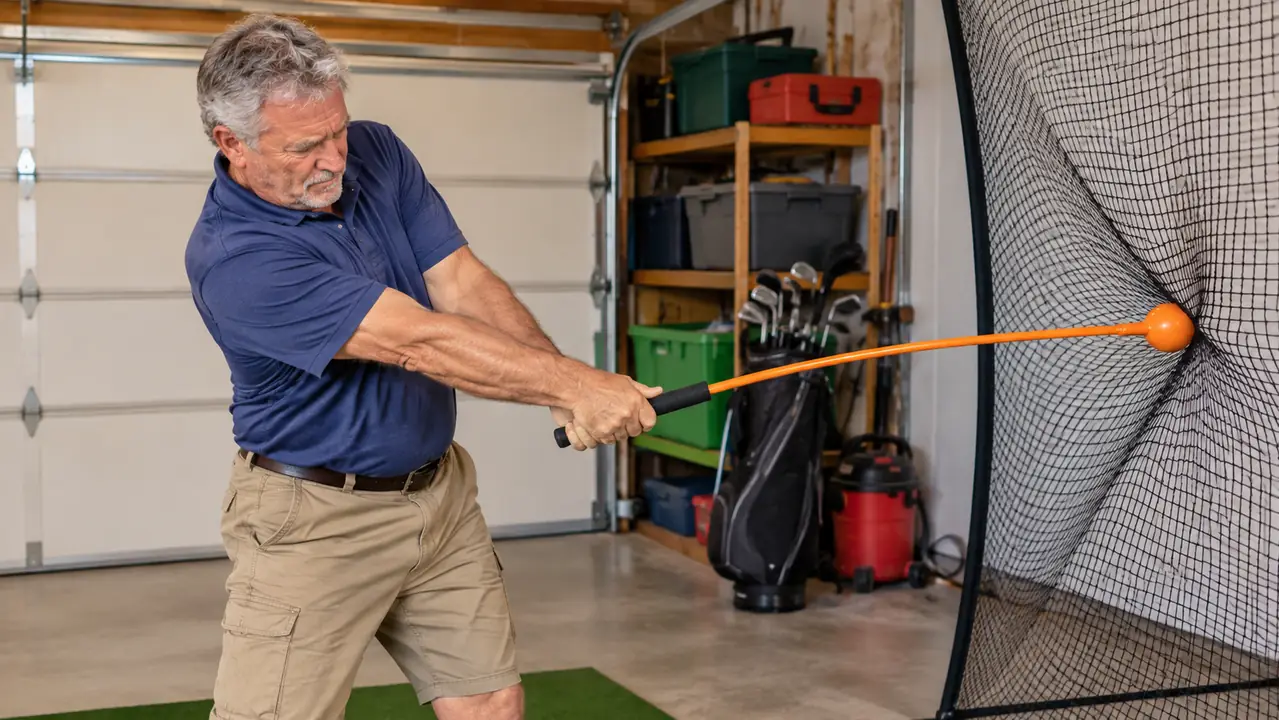
The Orange Whip is 47 inches long and weighs 1.9 pounds, and the flexible graphite shaft does something a normal club cannot do. When you slow your swing down, you can feel the shaft load up and release. That feeling is your tempo teacher. I take the club back slowly, stop at the top, and count a full beat before I start down.
That pause is where my tempo used to fall apart. My hands wanted to start down before my backswing finished. Doing this with the Orange Whip made the pause obvious, because the flexible shaft keeps loading the whole time you wait. After a few weeks, that beat at the top started showing up in my real swing without me thinking about it.
I count out loud when I do this. One on the way back, two at the top, three on the way down. It sounds silly standing alone in a garage, but saying the numbers out loud slows me down in a way that thinking them never did. The metronome app made everything worse, because I was chasing the beep instead of feeling the swing. Counting out loud with the Orange Whip in my hands gives me a rhythm I can actually feel, and that feeling is what carries over to the course. By the end of the session, I am not counting anymore. The swing just has a beat to it.
The pause also changed how I think about the downswing. I used to believe a fast swing meant a fast clubhead, so I tried to hurry everything. The Orange Whip showed me the opposite. When I pause at the top, the shaft loads up, and when I start down slowly, the weighted head actually speeds up on its own as the shaft unloads. The club does the accelerating. My job is just to stay out of its way. That one idea, that the swing can speed up after a pause, is what finally fixed my tempo.
Step 3: Let the shaft set the rhythm, not your hands
The Orange Whip's flexible shaft coordinates the rhythm between your arms, your upper body, and your lower body. That is not marketing talk, that is what it does. When you swing too hard with your hands, the shaft wobbles and you feel it instantly. When you let your body turn first, the shaft stays quiet and the head trails through smoothly.
I do ten slow-motion swings here, focusing on one thing only: letting the weighted head lead the way down. The head weighs just enough that you cannot fake it with arm strength. You have to let your lower body start the downswing or the whole thing feels wrong. That feeling, once you find it, is the tempo you are trying to build.

Step 4: Build strength without building tension
The Orange Whip also works as a strength tool. Because the shaft is flexible, your forearms, shoulders, and core have to work through the whole swing to keep the head under control. I do two sets of eight controlled swings, then two sets of eight the other direction. Left-handed swings are awkward at first, and that is exactly why they are worth doing.
The goal here is not to hit the net hard. The goal is to swing smooth. If I feel my shoulders creeping up toward my ears, I stop and reset. Tension is the enemy of tempo. Fifteen minutes with the Orange Whip has done more for my swing strength than the heavier club I used to keep in the garage, because it trains the timing along with the muscles. The strength came as a side effect of chasing tempo, not the other way around.
Step 5: Finish with a smooth through-swing
I finish every session with five full swings into the hitting net, trying to carry the same tempo I just practiced. The Orange Whip is a wood golf club with a synthetic rubber grip, and it is built to be swung, so I do not baby it here. Smooth back, that beat at the top, lower body leading the way down, and a full finish where the shaft wraps around my body.
The through-swing is where I used to quit early. I would stop the club at impact and let the ball do the work. With the Orange Whip, the weighted head pulls you through to a full finish, and that full finish is what keeps my lower back loose instead of locked up. Five good swings beats twenty rushed ones, every single time. On the course, that full finish is the difference between a smooth round and one where I am reaching for my back by the back nine.
What Else Helps
The Orange Whip is the center of my routine, but it is not the whole routine. I stretch my hips before I start, I put the hitting net at a distance where I have to finish my swing instead of stopping early, and I swing in bare feet on a firm mat so I can feel my weight shift. I also keep the sessions short. Fifteen minutes, five days a week, beat one long session on Sunday that leaves me stiff on the couch watching football.
One honest note: the Orange Whip will not fix a swing that has a mechanical problem you have never addressed. It builds tempo, rhythm, flexibility, balance, and strength, and it is great at all of those. If you are slicing every ball because your setup is wrong, take a lesson too. The trainer makes a good swing smoother. It does not manufacture one from nothing.
A few other small things made a difference. I put a strip of tape on the garage floor where I stand, so my feet land in the same spot every session. I do the routine in the morning on weekdays, because my back is stiffest when I first get up. Sundays I watch football on the couch and stiffen up, so Monday morning is when I need the routine the most. I also keep the Orange Whip leaning by the garage door, not buried in a corner. If it is out where I can see it, I actually use it. The whole thing takes less time than a pot of coffee.
I will also say this about consistency: five days a week for six weeks did more than two-hour sessions once a month ever did. The routine is boring on purpose. There is nothing exciting about ten shoulder turns and ten slow swings, but boring is repeatable, and repeatable is what builds a new feel into your swing. My Tuesday league scores did not drop overnight. They crept down over a couple of months, and the rounds stopped being a battle with my own back. Karen noticed before I did, because I stopped complaining about Sunday stiffness on Monday mornings.
The pause at the top is where my tempo used to fall apart. The Orange Whip made that pause obvious, because the flexible shaft keeps loading the whole time you wait.
Your tempo is hiding in your garage
You do not need a simulator or a coach on the phone to build a smoother swing. You need a trainer that shows you the rhythm and a place to swing it. The Orange Whip is the exact trainer I use, and it ships from Amazon with a 2-year warranty. Check today's price and start your first five-step session tonight.
Amazon Check Today's Price on Amazon →