
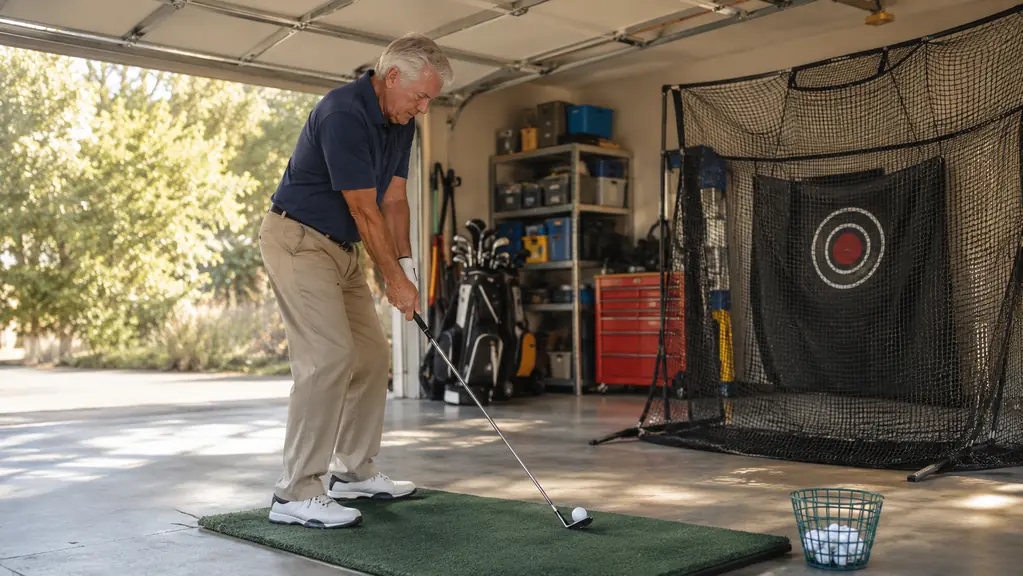
Back when I was 58, I stepped onto the first tee on a cold morning, took a full swing, and felt my right side grab on the follow-through. I finished that round swinging at half speed. I'm Gary Lindqvist, 61, a retired HVAC contractor in Mesa, Arizona. I play a Tuesday league round and a Saturday round with friends most weeks, I carry a 16 handicap, and my doctor calls my problem muscular strain, not a disc injury and nothing that needs surgery. It is a lower back that stiffens up when I sit too long and then try to swing hard. So I went looking for a training aid, and the two that kept coming up were the Orange Whip Golf Swing Trainer and a plain weighted swing club.
Here is the short answer. The Orange Whip is a tempo and rhythm trainer that swings close to a real club, and a weighted swing club is a resistance tool that makes your muscles work harder. They overlap a little, but they are not the same job. For a 61-year-old weekend golfer trying to get his swing back without re-aggravating his back, the Orange Whip fits better. For a golfer who just wants cheap strength work, the weighted club has the edge.
| Orange Whip Swing Trainer | Weighted Swing Club | |
|---|---|---|
| Price | One-time cost, see today's price | Usually the lower-cost option |
| Weight | 1.9 pounds, close to a real club | Heavier, typically 2 to 4 pounds |
| Shaft & Material | Flexible graphite shaft, patented flex coordinates arms, upper body, and lower body | Stiff shaft, no flex to learn |
| Head | Weighted spherical head on a 47-inch club | Weighted head, usually heavier |
| Use case | Tempo, rhythm, and swing mechanics | Strength and warm-up swings |
| Warranty | 2-year warranty | Varies by brand, often none |
| Made in | Patented and made in USA | Mostly imported |
How I Tested Both
I spent about six weeks with each one, which felt fair. With the Orange Whip I worked in the garage in front of my hitting net, ten or twelve slow swings at a time, two or three times a week, plus a few swings before Tuesday league rounds. With the weighted club I did the same number of swings but slower, more like a warm-up lift than a golf swing. I kept a note in my phone about how my back felt the next morning, because that was the whole point.
One honest caveat before I go further: I am not a coach and I am not a physical therapist. I am a retired HVAC contractor who plays a 16 handicap and has a stiff right side. Everything below is what I felt, not what a lab measured. If your pain is sharp, radiating, or new, go see your own doctor before you buy anything.
What Each Tool Actually Does
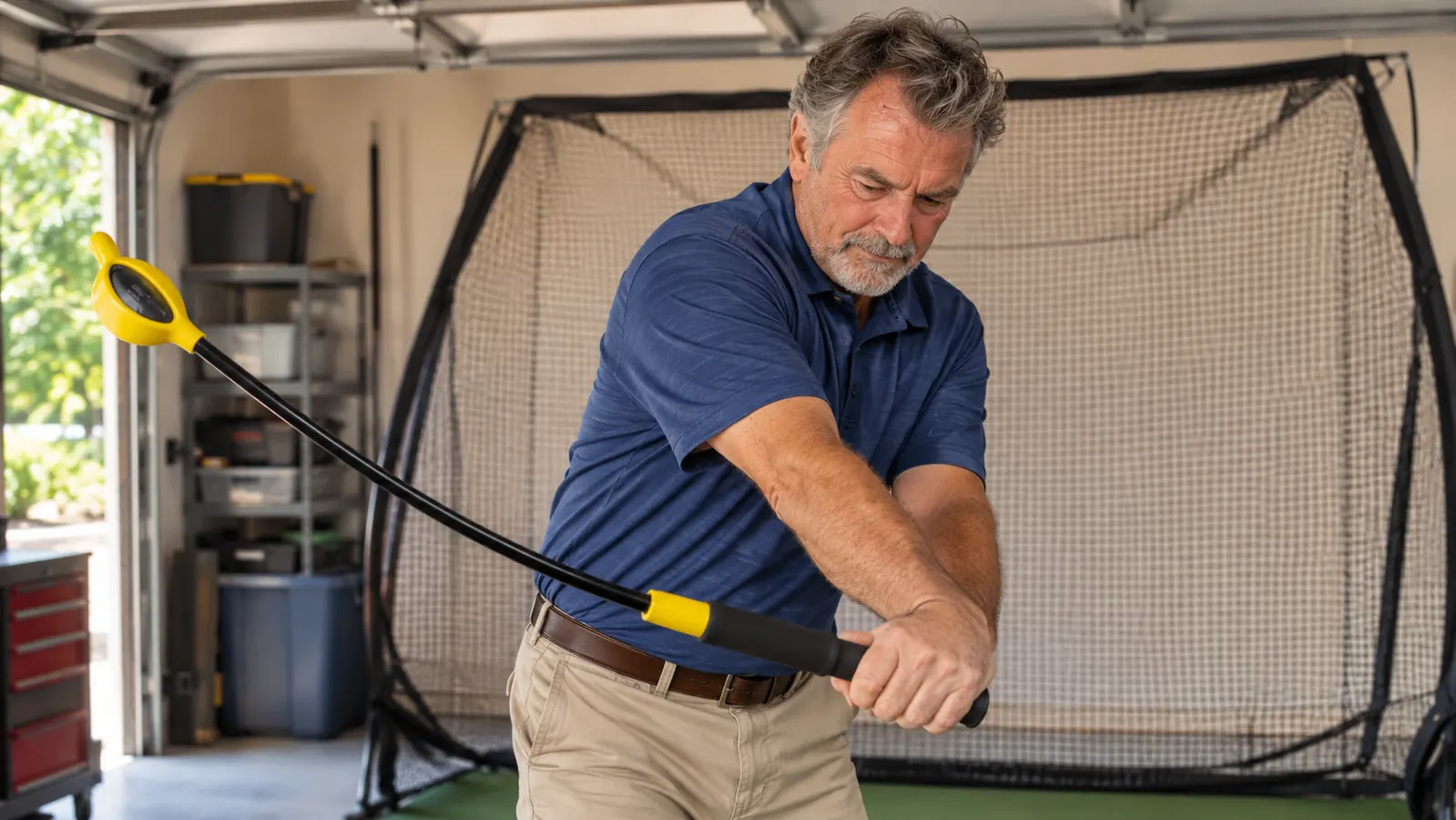
The Orange Whip is a 47-inch training club with a flexible graphite shaft, a weighted spherical head, and a synthetic rubber grip. It weighs 1.9 pounds, about what a real club weighs, and it is ambidextrous, so it works for right- or left-handed golfers. The whole idea is the flex. When you swing it, the shaft bends and loads, then snaps back, and that rhythm is what coordinates your arms, your upper body, and your lower body. You are not building big muscles with it. You are teaching your body to swing in the right order, and it is patented and made in the USA, with a 2-year warranty.
A weighted swing club is the opposite idea. It is a stiff club, usually heavier than a normal club, and you swing it slowly to build strength and loosen up. Pro shops sell them under a dozen names and they are usually the lower-cost option. They do one thing well: they add resistance. You cannot really groove a tempo with one, because the extra weight changes the feel of the swing. You can absolutely get your arms, shoulders, and core working harder, a fine job, just a different one.
Where the Orange Whip Wins
The Orange Whip wins on the thing most of us actually need: fixing the order of the swing. My problem was never strength. It was starting the downswing with my arms and letting my lower back catch up late, which is exactly how I pulled it that cold morning. The flex in the shaft punishes that. If you start with your hands, the shaft bends and you feel it immediately. If you let your lower body lead and your arms follow, the shaft loads and releases smooth. It gives you feedback on every single swing, and you do not need a coach to feel it.
It also wins on warranty and on where it is made. The Orange Whip comes with a 2-year warranty and it is patented and made in the USA. The weighted club I borrowed had no warranty to speak of, and most of that category is imported. For a tool I planned to swing twice a week for years, that mattered. And at 1.9 pounds it swings close enough to my real clubs that what I practice in the garage shows up on the course. That transfer is the whole point of a trainer.
Where a Weighted Swing Club Wins
The weighted club wins on price, and I am not going to pretend otherwise. It is usually the lower-cost option, you can find one in any pro shop, and if you only want to add resistance to your warm-up, it does that job for less money. It is also simpler. There is no flex to learn and no rhythm to figure out. You pick it up, you swing it slow, and you feel it in your forearms and shoulders the next morning. Some golfers love exactly that.
It wins for a specific kind of golfer too: the one who is already swinging in decent order and just wants to get stronger, or the one who wants a heavy warm-up club to swing in the parking lot before a round. If strength is your only problem, the weighted club is the honest answer. It is also easier to throw in the trunk, and if it gets banged up, you are not out much.
If your swing is out of order, the Orange Whip gives you feedback on every rep
The flexible shaft coordinates your arms, upper body, and lower body, and the 2-year warranty makes the one-time cost easier to swallow. Check today's price on Amazon.
Amazon Check Today's Price on Amazon →The Back Factor
Now the part that mattered most: my back. My doctor was clear that this is muscular strain, not a disc problem, and he told me to warm up before I swing and to stop swinging through sharp pain. The Orange Whip fit that advice better than the weighted club did. Because it swings at nearly the same weight as a real club, I could groove a smooth tempo without adding load to a stiff lower back. The weighted club added resistance, and resistance on a cold, stiff back on a Saturday morning is exactly what I do not need.
Your situation may be different. If your pain is sharp, radiating, or new, do not take my word for it, go see your own doctor. I am not a physical therapist and I am not pretending to be one. All I can tell you is what my doctor told me and what I felt: slow, smooth swings with a club that matches my real club weight kept me loose. Heavy resistance swings made me sore in the wrong places.
Because it swings at nearly the same weight as a real club, I could groove a smooth tempo without adding load to a stiff lower back.

What Surprised Me
What surprised me most was how much the Orange Whip felt like a real club and how little the weighted club did. With the weighted club, I finished a set of swings and felt my arms burning, but my swing felt no different when I put it down and picked up my 7-iron. With the Orange Whip, the opposite happened. I did not feel worked out at all, but the first few real swings after it were smoother, especially the transition from backswing to downswing, which is exactly where my tempo used to fall apart.
The other surprise was the 1.9-pound weight. I expected a training aid to feel heavier, like the weighted club. It does not. It feels like a normal club that happens to bend, and that is the point. You are practicing the actual swing you will use on the course, not a heavier version of it. For a guy whose back complains when he changes things too fast, that gentleness was a feature, not a bug.
How to Use Either One
Here is how I used the Orange Whip. Start with five or six slow swings in the garage, no ball, just the motion. Let the shaft bend on the backswing and release on the downswing. Do that twice a day for the first week, then add a few swings before a round. Ten or twelve swings is plenty. You are grooving a rhythm, not doing a workout.
If you go with a weighted club, use it the way the pro shop told me: slow, controlled swings, both directions, and stop before you get tired. It is a warm-up and strength tool, not a speed tool. Swinging it fast is how people hurt their shoulders. And if you have any doubt about your back, start with the lightest one they carry and keep the swings short.
Alternatives I Considered
Before these two, I looked at other options. There are heavy training grips that slip over your real club, and there are speed sticks that are lighter than a normal club. The grip adds weight to the club you already own, a cheap way to test whether you like resistance training. The speed stick is the opposite idea, it trains fast tempo, but it felt too far from my real swing weight, and the flex of the Orange Whip gave me the same tempo lesson without the whippy feel.
I also considered just doing more stretching in the spare bedroom, which is where I do my morning routine. That helped, and I still do it. But stretching alone did not fix the order of my swing. The trainer did. If you are on the fence, that is the honest sequence: stretch first, then add a trainer, and only add resistance work if your back is happy with the first two.
Who Should Buy Which
Buy the Orange Whip if you want to fix your tempo, if your swing falls apart when you get tired, if you want feedback you can feel without a coach, or if your back complains when you swing cold. It is the tool I kept in the garage, and the 2-year warranty backs it. Buy a weighted swing club if your swing is already in decent shape and you just want cheap resistance work, or if you want a heavy warm-up club to swing in the parking lot before a round.
For me, a 16-handicap weekend golfer trying to keep his lower back happy, the Orange Whip is the one that stayed. The weighted club went back where I borrowed it from. That is not because the weighted club is bad. It is because my problem was never strength. My problem was tempo, and tempo is what the Orange Whip trains. Figure out which problem you have, and the choice gets easy.
The Bottom Line
In one sentence: the Orange Whip is for golfers whose swing is out of order, and the weighted club is for golfers whose swing is fine but whose muscles are not. Most weekend golfers I know, including me, are in the first group. We do not need to hit harder. We need to hit in the right sequence, with a lower back that stays quiet while we do it.
The Orange Whip will not fix a bad grip or a bad setup on its own. It is a practice tool, and it only works if you use it. Ten slow swings a few times a week, before rounds and on days you are not playing, is enough to feel the difference. The 2-year warranty and the made-in-USA build back that up. Check today's price on Amazon. If your problem is tempo like mine was, you will know which one to pick.
The Orange Whip is the trainer I kept in the garage
It swings like a real club, gives you feedback on every rep, and comes with a 2-year warranty. Check today's price on Amazon and decide for yourself.
Amazon Check Today's Price on Amazon →