
I have a Tuesday league round and a Saturday game with the same three guys, and for about a year my lower back made both of them a gamble. Some mornings I would step onto the first tee feeling fine, then bend to set the ball and feel that familiar grab on the right side. Some rounds I played through it and paid for it on the couch Sunday. My doctor called it muscular strain, no disc injury, and told me to keep moving but think about support on the days I played. That is when I started looking into a back brace for golf, and specifically how to wear one so it helps instead of just feeling like a belt you forgot to take off.
I am Gary, 61, retired HVAC contractor in Mesa, Arizona, and I carry a 16 handicap that I defend more than I improve. I am not a doctor and I am not going to talk like one. What I can tell you is what the Sparthos back brace did for me over a full season of Tuesday and Saturday rounds, how I learned to fit it, when I wear it, and when I leave it in the car. If your pain is sharp, radiating down a leg, or new to you, check with your own doctor before you buy anything. For the kind of stiffness I deal with, this brace has been a genuine help.
The Sparthos back brace I reach for before every league round
Adjustable, breathable, and light enough to forget you are wearing it by the third hole. It supports the lower back without turning your swing into a rehearsal for a robot.
Amazon Check Today's Price on Amazon →Step 1: Put It On Standing, Not Sitting
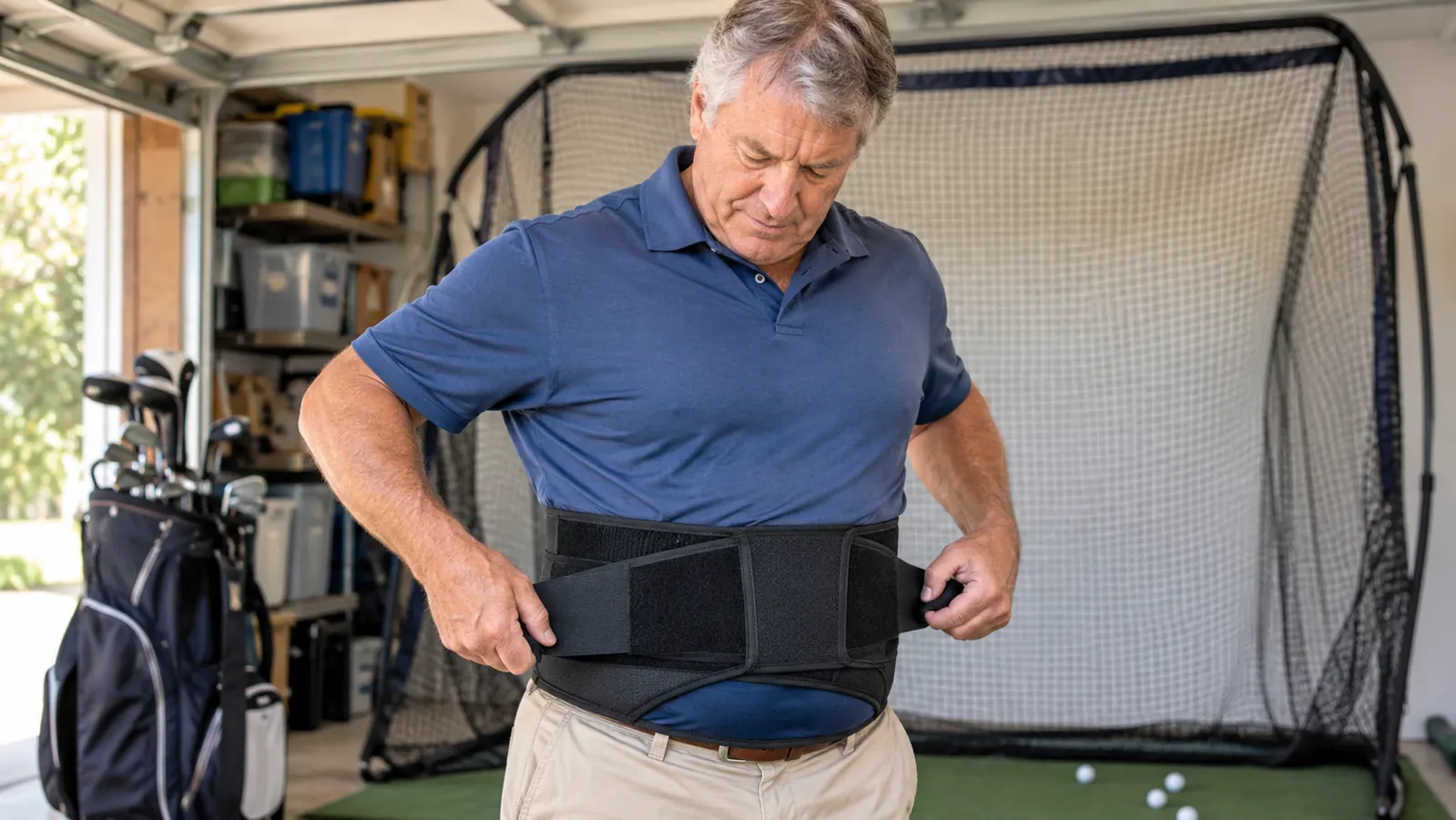
The first mistake I made was putting the brace on while I was sitting in the car at the course. It felt snug in the parking lot, then the moment I stood up it shifted and I spent the first two holes tugging at it. Now I put it on standing, usually in the garage before I load the clubs. Standing is the position your back will actually be in for most of the round, so that is the position you should fit it in.
Unwrap the Sparthos and let the removable lumbar pad sit against your lower back, centered over the area that bothers you. The pad is the part that does the real work, so take the extra ten seconds to position it rather than just slapping the belt on. I aim for the pad to cover the spot right around my belt line, slightly lower than I first expected. The first time I wore it too high and it pressed on the wrong part of my spine. Lower, over the curve of the lower back, felt right. I learned that the hard way on a cold Tuesday in February when I wrapped it on like a weight belt in a hurry. It sat too high, and by the fourth hole I had a sore spot on my ribs and a brace that kept sliding. The next round I centered the pad in front of the bathroom mirror before cinching the straps, and it stayed put for all 18. Once the hook and loop straps are snug, the pad is not going to move on its own, so the thirty seconds you spend positioning it before you tighten are the most important thirty seconds of the whole process.
Hold the brace in place with one hand and pull the hook and loop straps with the other. Pull them snug, not tight. You want the brace to feel like a firm hand on your back, not like a vise. I have worn it on 80 degree mornings and it breathes well enough that I do not think about it, which is exactly what you want from a piece of gear.
Step 2: Get the Tension Right Before You Swing
Too loose and the brace slides around when you rotate. Too tight and it restricts your turn, which for a guy with my swing is already a limited resource. The right tension is the one where you can take a full practice swing in the garage and not feel the brace shift or pinch. I test mine with three practice swings before I leave for the course. If it moves, I adjust it. That takes about thirty seconds and saves me an entire round of fiddling.
The Sparthos is adjustable, which matters more than I realized. The hook and loop closure means I can fine-tune it between the parking lot and the first tee. I tend to set it a touch firmer for the first few holes when my back is still cold, then loosen it slightly after I have warmed up. That is not something I could do with a brace that only had one setting.
One thing I learned the hard way: do not crank it down because you think more support is better. Over-tightening made my back feel worse by the back nine because it changed the way I rotated. I remember one Tuesday in late March when I cinched it extra firm because my back felt tight on the drive to the course. I played the first few holes fine, even birdied the second, and thought I had figured something out. By the turn I was rotating stiff and favoring my right side, swinging like a man ten years older. I loosened the straps a half inch on the tee box at 10 and felt normal again by 12. That round taught me the brace is a reminder, not a crutch. Firm enough to feel, loose enough to forget.
Step 3: Wear It Over a Thin Layer
The Sparthos is made from nylon, plastic, and polyester, and it is breathable, but I still wear it over a thin undershirt or a light polo rather than against bare skin. That keeps it from sliding and makes it easier to take off between holes if I need a break. On hot Mesa mornings, the breathable fabric makes a bigger difference than I expected. I have worn it for a full 18 in the summer and it did not turn into a sweat trap.
Tuck the brace under your shirt if you want it out of the way, or wear it over your polo if you want to adjust it easily. I wear it over a thin layer and under my outer shirt. That keeps it from catching the wind on cool mornings and keeps it from snagging on anything when I reach into my bag.
If you walk 9 like I do most weeks, you will notice the brace stays put better when it is against a layer with some grip. If you ride 18, you will probably want it a little looser in the cart and snugger when you are standing over the ball. That is the beauty of the hook and loop closure: you can adjust it between shots without taking it off.

Step 4: Time It Around Your Round
The timing question is the one I get asked most by the guys in my league, and the honest answer is that I wear it differently depending on the day. On cold mornings, I put it on before I leave the house and keep it on through the first few holes. On warm afternoons, I put it on at the course after my warmup swings. The brace is not a warmup. It is support. I still do my stretching and take my practice swings, then add the brace on top.
I also wear it for the 20 minutes after the round when I am loading clubs and standing around the parking lot. That is when my back used to stiffen up, especially on Sundays when I would go straight from the course to the couch for football. Wearing the brace through the cooldown, then taking it off once I am home and moving around, has made a real difference in how I feel Monday morning. The Sunday test is the one I trust most. One May weekend I skipped the cooldown, came home, and sat through the whole afternoon of NFL games without the brace. By the late game I could barely bend to pick up the remote. The next Saturday I wore it through the parking lot, through unloading the clubs, and for about twenty minutes on the couch until I got up to start dinner. Monday morning felt like a normal Monday instead of a stiff one. It is not a dramatic difference, but it is the difference between starting the week sore and starting the week fine.
A note on the other direction: I do not wear it all day. The Sparthos is a tool for the activity, not a permanent accessory. My doctor was clear that a brace should support you during the things that strain your back, not replace the muscles that need to stay strong. I wear it for golf, for the drive home, and sometimes for yard work. Then it comes off.
Step 5: Loosen It Between Shots and on the Cart
The most useful trick I picked up is loosening the brace between shots. When I am walking to my ball or sitting in the cart, I give the straps a half inch of slack. When I get to my ball and start my routine, I snug it back up. It takes three seconds and it means the brace is working when I need it and resting my back when I do not.
If you ride 18 like I do on Saturdays, the cart is where your back actually stiffens up. Sitting for five minutes between shots is harder on a stiff lower back than walking. I keep the brace snug while I am riding, then loosen it slightly when I am standing over a putt. That might sound like a lot of fiddling, but after a few rounds it becomes automatic.
The Sparthos weighs 0.37 kg, which is light enough that I forget I am wearing it by the third hole. That is the real test. If you are thinking about the brace all round, something is wrong with the fit or the timing. When it is right, you notice your back more than you notice the brace.
What Else Helps
The brace is one piece of the puzzle, not the whole puzzle. What actually kept me playing twice a week was the combination: the Sparthos for support during the round, a ten minute stretching routine in the spare bedroom before I leave, and a commitment to not sitting in the cart for the full 18. The stretching is boring and I will not pretend otherwise. Same five moves my doctor showed me, mostly hamstring and hip flexor work, done in the spare bedroom on Tuesday and Saturday mornings and again on Sunday evening even when I would rather be on the couch. The garage hitting net gets used almost as much. Three or four slow practice swings a day, focusing on a full turn without forcing it, has done more for my back than any single piece of gear. I also stopped trying to crush the ball off every tee. A smooth swing with a 16 handicap is worth more than a heroic one that leaves me stiff on Sunday. The brace supports the round. The routine keeps me ready for the next one.
If you are considering the Sparthos, know what it is and what it is not. It is a lightweight, adjustable, breathable back brace with a removable lumbar pad, designed for support during activity. It is not a cure for a bad swing, a weak core, or a back problem that needs a doctor's attention. For the golfer with recurring stiffness who wants to keep playing, it is a genuinely useful piece of gear. For the golfer hoping a belt will fix everything, it will disappoint.
When the fit is right, you notice your back more than you notice the brace. That is the whole test.
If your back is the reason you almost skipped the round, this is worth a look
The Sparthos back brace is adjustable, breathable, and light enough to wear through 18 holes. Fit it standing, time it around your round, and let it do its job.
Amazon Check Today's Price on Amazon →