

I do not know about you, but the walk off the 18th green is never my problem. The problem shows up about an hour later, when I sit down to take my golf shoes off and my right side reminds me I swung a club 90 times. I am Gary, I am 61, I live in Mesa, and I have carried a 16 handicap for longer than I care to admit. My lower back started acting up when I was 58, after a cold-morning round, and my doctor called it muscular strain. No surgery, no disc injury, just stiffness and soreness on the right side that likes to hang around. I tried a lot of things to loosen up after golf, and the one that keeps making my Tuesday and Saturday nights better is a heating pad. Not a fancy one, just a large RENPHO heating pad with six heat levels and a timer I can set and forget.
This is not medical advice. I am not a doctor or a physical therapist, and if your pain is sharp, radiating, or new, go see your own doctor before you buy anything. What I am is a guy who spent a full season either skipping rounds or playing through stiffness, and then found a 20-minute routine that actually helps. Here is the routine, step by step, the way I do it.
The heating pad I keep on the couch for post-round stiffness
A 24 by 33 inch flannel pad with 6 heat levels and a 3-hour auto-off timer. I use it for 20 minutes after every round, and it is the reason my Sundays stopped being couch-bound.
Amazon Check Today's Price on Amazon →Step 1: Give yourself 20 minutes before you do anything else
The biggest mistake I made for two full seasons was treating the stiffness like something I could ignore. I would get home, eat lunch, sit in the recliner, and then wonder why my back felt worse by dinner. Heat works best when you use it before the muscles have a chance to tighten up all the way. So now my rule is simple: within an hour of getting home, I spend 20 minutes with the RENPHO pad on my lower back.
I keep the pad on the couch in the living room, draped over the back of the seat, so it is ready when I walk in. That matters more than you think. If I have to dig it out of a closet, I will tell myself I will do it later, and later never comes. The pad is 23.62 x 11.81 inches, which is a lot of coverage for a lower back, and it is made of flannel, so it does not slide off the couch the way a towel does.
The Tuesday league taught me why the timing matters. Back in March, I shot an 89, which for me is a genuinely good round, and I was so pleased with myself that I skipped the pad entirely. My thinking was simple: a good round means a good back, right? By seven that evening I was on the kitchen floor trying to stretch out a right side that had gone from stiff to locked. Karen found me there and, to her credit, did not say I told you so. She just pointed at the couch. That was the last time I skipped the routine. The stiffness always shows up later if I do not deal with it early, and dealing with it early takes less time than dealing with it at seven o'clock.
Step 2: Set the heat level and the timer before you lie down
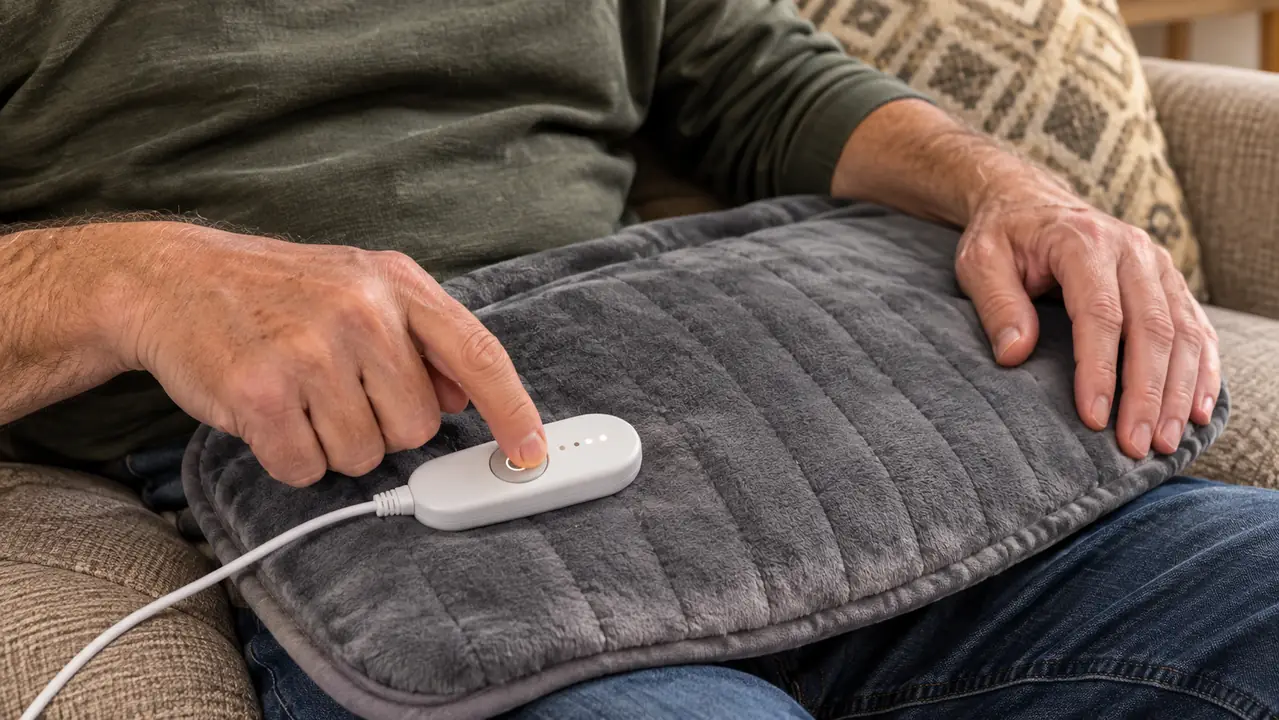
The RENPHO controller has six heat levels, from about 100 degrees up to about 150 degrees, and a timer that shuts the pad off automatically. I start on level 3 for the first five minutes and then bump it to 4. Level 5 is fine if I am really tight, but I do not start there, because the point is to let the muscles ease in, not to blast them. If I set it on high right away, I end up turning it down two minutes later and breaking my own relaxation.
I set the timer for 20 minutes every time. The pad will shut off after 60 minutes if I do not set a timer at all, but 20 is my number. It is long enough to feel the difference and short enough that I do not fall asleep on the couch and wake up two hours later, which I have absolutely done. The auto-off feature is not a gimmick to me, it is the reason I can lie there without watching the clock.
Step 3: Lie flat, not propped up
Here is the thing I figured out by trial and error: position matters as much as heat. If I lie on the couch propped up on pillows, my lower back is still curled, and the heat has to work against that. If I lie flat on my back with the pad under me, right at the belt line, my spine is in a neutral position and the heat sinks in where it is supposed to.
I put the RENPHO pad directly on my skin, not over a shirt. The flannel is soft enough that this does not bother me, and it gets the heat where the stiffness actually is. If you are sensitive to heat, keep a thin t-shirt on, but know that you are adding a layer between the pad and the muscle. I learned this the hard way during my first season with the pad, when I used it over a sweatshirt and wondered why it did not feel like anything.
The first time I tried lying flat, I remember thinking this is going to be a waste of twenty minutes. I was used to sitting up, reading the paper, and letting the pad work in the background. But I had read that flat is better for a strained lower back, so I gave it a real try on a Saturday night after a long round. The proof came the next morning. Instead of that first-step wince when I got out of bed, my back just moved. Not cured, not perfect, but noticeably looser. That was the moment I stopped treating the pad like a couch accessory and started treating it like part of the recovery. Now I position it so the top edge sits right at my belt line, which covers the exact spot where my stiffness lives, on the right side just above the hip.

Step 4: Move a little before the 20 minutes are up
Somewhere around the 15 minute mark, I do three or four slow knee-to-chest pulls, one leg at a time, still lying flat with the pad under me. Nothing dramatic, just enough to remind my lower back that it can move without guarding. I am not a flexible guy, and I am not trying to become one. I am trying to get the muscles to remember they are allowed to relax.
When the timer clicks off, I stay on the floor for another minute before I stand up. That sounds like nothing, but it is the difference between a smooth transition and that little wince you get when you stand up too fast. The warmth stays with me for a while after the pad is off, and that lingering heat is honestly the best part of the whole routine.
Step 5: Do the same thing on Sunday, even if you did not play
My worst stiffness of the week used to hit on Sunday afternoons, when I would sit on the couch watching football for three hours. I do not play on Sundays, but I still use the pad. Ten minutes at level 3 while I watch the first quarter keeps the stiffness from building up the way it used to. The RENPHO pad is not just a post-round tool anymore, it is a Sunday afternoon tool too, and that is where it earns its keep.
I also keep it in the spare bedroom on the nights when I want to stretch before bed. I lay it on the floor next to my mat, do my stretches, then finish with the pad on my back for 15 minutes. The pad weighs about 1.98 pounds, so it is easy to carry from the couch to the bedroom and back. It runs on standard 120V power and draws 50 watts, which means I do not think about the electric bill when I use it.
The Sunday routine started by accident last fall. I had played eighteen holes with the Saturday group, and by Sunday afternoon I was three hours into the early games, sitting in the recliner with my back curled. Around the second quarter I realized I could not stand up without holding the armrest. I dragged myself to the couch, set the pad on level 3, and lay flat for the rest of the half. By the fourth quarter I was in the kitchen making a sandwich without thinking about my back. Now I do not wait for the warning. The pad goes on the couch before the pregame show ends, and I spend the first quarter lying flat with it on. It turned Sunday from the worst day of my week into a day I actually look forward to.
What Else Helps
Heat is the part of my routine that made the biggest difference, but it is not the only part. I drink more water on golf days now, and I noticed that helps. I also do a few minutes of gentle stretching the morning after a round, nothing heroic, just touching my toes and twisting slowly side to side. My doctor told me to keep moving, and the heating pad makes that easier because the muscles are not fighting me.
If you are thinking about buying a heating pad for golf recovery, the RENPHO is the one I would point you to. It is large enough to cover the whole lower back, the flannel feels good against the skin, the six heat levels give you room to find your own setting, and the timer means you can actually relax instead of watching the clock. It is also FSA and HSA eligible, which is a nice detail if you have one of those accounts. I did not buy mine for that reason, but I would have appreciated knowing it before I paid for it out of pocket.
Before I found the pad, I tried the things most guys try. I tried a bag of frozen peas wrapped in a dish towel, and it helped for about twenty minutes, then the cold made everything tighter. I tried a microwaveable rice pack, and it was fine until it cooled off halfway through the second quarter, and then I was up and down reheating it all night. I even tried just taking ibuprofen and ignoring the stiffness, which worked until the ibuprofen wore off. The RENPHO pad is the first thing that stays warm for the whole twenty minutes without me getting up to fix it. That consistency is what made the difference, not any particular heat level. It just does its job, quietly, for as long as I need it.
The 20 minutes I spend on the couch with the RENPHO pad after a round are the reason I can still play twice a week at 61.
One more honest note: a heating pad will not fix a bad swing or a real injury. If your back hurts when you wake up, or the pain shoots down your leg, or it started after a fall, do not reach for a pad, reach for the phone and call your doctor. Heat is for the kind of stiffness that shows up after a long day of golf and fades when you take care of it. That is the kind I have, and that is the kind this routine is built for.
Loosen up tonight, not tomorrow
Twenty minutes on the couch with the RENPHO heating pad after your next round. Six heat levels, a timer you can set and forget, and flannel that feels good against your skin.
Amazon Check Today's Price on Amazon →